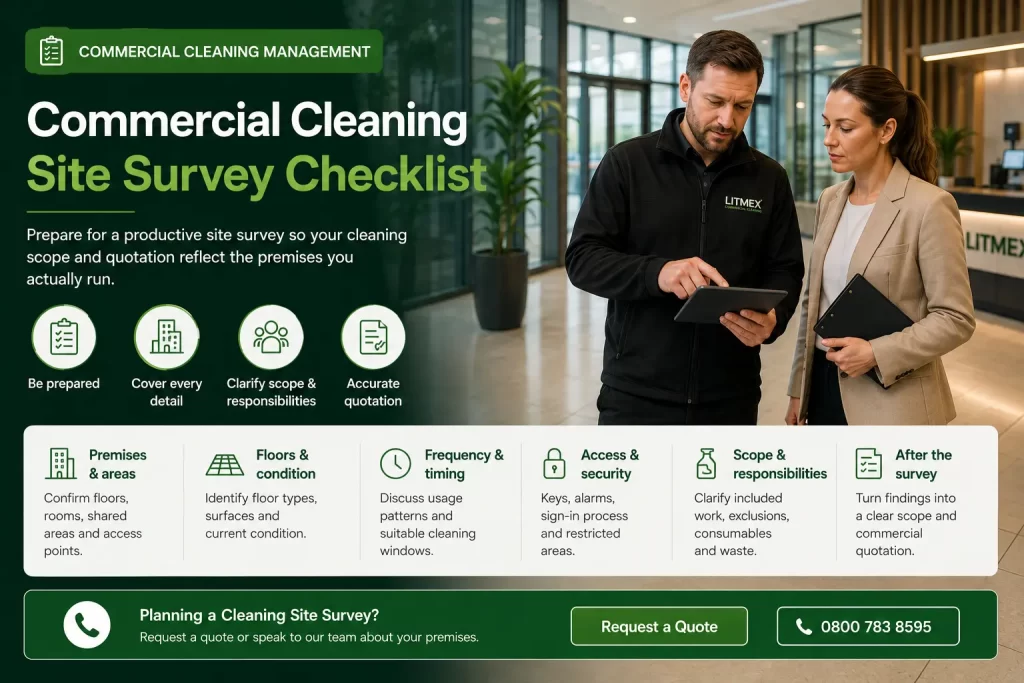
Commercial Cleaning Site Survey Checklist: What Happens During a Survey?
This commercial cleaning site survey checklist helps facilities managers, office managers, property managers and commercial buyers prepare for a useful premises walkthrough before the cleaning scope and quotation are finalised.
A site survey should do more than record the size of a building. It should help clarify how the premises is used, which areas actually need cleaning, the condition and type of floors and surfaces, suitable cleaning times, access arrangements, current priorities and any boundaries that could otherwise become assumptions in a quotation.
What Happens at a Commercial Cleaning Site Survey?
A commercial cleaning site survey is an on-site walkthrough used to check the premises, cleaning requirement, operating conditions and assumptions that may affect the proposed service. It can help confirm the areas in scope, building usage, floor and surface types, preferred frequency, access restrictions, current cleaning issues, responsibilities and work that may need separate consideration.
The commercial cleaning site survey checklist is therefore not simply a measurement exercise. It is a practical way of replacing assumptions with information before a cleaning specification or quotation is finalised.
If the required cleaning tasks and frequencies still need to be formally defined, also see the Commercial Cleaning Specification Checklist .
- Why the site survey matters
- Why floor area alone is not enough
- What to prepare before the visit
- What to check during the walkthrough
- Floors, surfaces and current condition
- Current cleaning problems and priorities
- Frequency and cleaning windows
- Access, security and site logistics
- Responsibilities and exclusions
- What happens after the survey
- Final site survey checklist
Why a Commercial Cleaning Site Survey Checklist Matters
Cleaning quotations are easier to compare when the buyer and provider are working from the same understanding of the building. A walkthrough gives both sides an opportunity to see how the premises operates, where cleaning demand is concentrated and which practical constraints need to be considered before the service is priced or planned.
Verify the physical site
- Confirm Relevant Floors And Areas
- See How Spaces Connect
- Identify High-Use Routes
- Check Restricted Or Specialist Areas
Understand building use
- Discuss Opening Hours
- Consider Staff And Visitor Patterns
- Identify Busy And Quiet Periods
- Check When Cleaning Can Take Place
Reduce assumptions
- Clarify Routine Cleaning
- Identify Periodic Requirements
- Separate Excluded Work
- Confirm Client Responsibilities
Useful test: a good survey should expose the assumptions that would otherwise remain hidden inside a commercial cleaning quotation.
Is a Cleaning Quotation Based Only on Floor Area?
No. Floor area helps indicate the scale of a premises, but two commercial sites with similar square footage can require very different cleaning arrangements. Layout, washroom numbers, kitchens, occupancy, floor finishes, footfall, existing condition and access restrictions can all change the amount and type of cleaning required.
A useful commercial cleaning site survey checklist therefore considers how the space functions as well as how large it is.
| Survey factor | What it tells you | Why it matters |
|---|---|---|
| Floor area | The approximate overall scale of the premises. | Useful as a starting point, but not enough to describe the full cleaning workload. |
| Layout | Whether the site is open plan or divided into many smaller rooms, corridors, stairs or units. | Equal floor areas can contain very different numbers of touchpoints and separate spaces. |
| Floor finishes | Carpet, vinyl, tiles, entrance matting and other surfaces. | Different surfaces can require different routine and periodic cleaning methods. |
| Washrooms | Number, size, fixtures and expected usage. | Washrooms can create concentrated cleaning demand within a small floor area. |
| Kitchens and welfare areas | How shared food, drink and break spaces are used. | Usage patterns can create different priorities from general workspace cleaning. |
| Occupancy and footfall | How intensively different areas are used. | Entrances and shared routes may need more frequent attention than low-use areas. |
| Current condition | Existing soil, marks, build-up or neglected areas. | Some work may need to be treated as an initial or periodic task rather than normal maintenance. |
| Access | When cleaners can enter and which areas they can reach. | Restricted cleaning windows can affect how a workable service is organised. |
What to Prepare Before a Commercial Cleaning Site Survey
The buyer does not necessarily need a complicated tender document before the visit. A small amount of accurate information makes the walkthrough more useful and reduces the time spent trying to establish basic facts about the premises.
Correct premises details
Confirm the building address, relevant unit or floors and the areas that are expected to form part of the cleaning requirement.
Main site contact
Ideally, someone who understands how the building operates should be available to answer practical questions about cleaning priorities, access and current issues.
Opening and operating hours
Explain when the building opens, when it is busiest and whether there are periods when cleaning would disrupt staff, visitors, customers or operations.
Overview of areas
Know the approximate number of floors, work areas, washrooms, kitchens, meeting rooms, shared routes and other site-specific spaces.
Current cleaning problems
Prepare examples of repeated complaints, areas that deteriorate quickly, access problems or tasks that are currently being missed.
Preferred timing and start needs
If there is already a preferred cleaning window or intended start period, raise it so the proposed service can be considered against the way the building operates.
Walk Through the Premises Area by Area
The walkthrough should follow the actual building rather than a generic room list. A commercial cleaning site survey checklist can provide structure, but only areas that genuinely exist at the site should become part of the proposed cleaning requirement.
Entrances and circulation
- Entrances And Reception
- Corridors And Shared Routes
- Stairs And Lifts
- High-Footfall Floor Areas
Working areas
- Offices And Workstations
- Meeting Rooms
- Customer-Facing Areas
- Site-Specific Operational Areas
Shared facilities
- Kitchens And Tea Points
- Washrooms
- Changing Or Welfare Areas
- Relevant Storage Areas
The emphasis changes with the type of commercial property. Offices may involve workstations, meeting rooms, kitchens and secure areas. Warehouses may place greater emphasis on large floor surfaces, operational routes and welfare facilities. Managed buildings can require closer attention to entrances, stairs, lifts, corridors and shared areas.
Check Floors, Surfaces and Their Current Condition
Floor and surface information is easy to overlook when the conversation focuses only on room names. A site can contain carpet, hard floors, entrance matting, tiled washrooms, glass, stainless steel, painted surfaces and other finishes that require different cleaning approaches.
The survey should also separate ordinary maintenance cleaning from work that may need periodic planning. A floor can be regularly vacuumed or mopped while still requiring separate carpet cleaning, polishing, floor maintenance or a more detailed initial clean.
Practical safety point: the Health and Safety Executive advises that cleaning methods and timing should take account of slip risks, including controlling pedestrian access where wet floors are present. See HSE guidance on cleaning and slip risks.
Show the Surveyor What Is Currently Going Wrong
One of the most valuable parts of a site survey is seeing existing cleaning problems in context. Instead of only saying that standards need to improve, show the specific places where problems occur and explain when they are most noticeable.
Cleaning issues worth showing
- Recurring Washroom Complaints
- Kitchen Or Tea-Point Build-Up
- Entrance Dirt At Busy Times
- Floor Marks Or Persistent Soil
- Bins Filling Faster Than Expected
- Frequently Missed Details
Operational issues worth explaining
- Cleaning Around Occupied Areas
- Previous Access Problems
- Areas That Cannot Be Cleaned At Certain Times
- Changes In Occupancy Or Footfall
- Tasks Better Treated As Periodic Work
- Recurring Service Complaints
A better survey question: rather than asking only how large the site is, ask which areas create the greatest cleaning demand and what causes it.
Discuss Cleaning Frequency and Suitable Working Windows
Cleaning frequency should reflect how different parts of the building are used. A busy entrance, washroom or communal route may create a different requirement from a meeting room or low-use workspace. The survey should therefore explore when cleaning is needed rather than applying one frequency automatically to the entire site.
| Survey question | What to discuss | Why it helps |
|---|---|---|
| When is the building busiest? | Staff attendance, visitors, customers, deliveries and peak periods. | Identifies when particular areas experience the greatest cleaning demand. |
| Which areas deteriorate fastest? | Entrances, washrooms, kitchens, lifts and shared routes where relevant. | Helps avoid using the same frequency for every area. |
| When can cleaning take place? | Early morning, daytime, evening, weekends or other suitable site windows. | Makes sure the proposed arrangement fits the site’s actual operation. |
| What is periodic rather than routine? | Carpet cleaning, deeper floor work, detailed cleaning and other non-routine tasks. | Prevents periodic requirements being hidden inside general cleaning wording. |
Check Access, Security and Site Logistics
A commercial cleaning site survey checklist should include practical access because even a clear cleaning scope can fail if cleaners cannot enter the premises or reach the necessary areas at the agreed time.
Entering the site
- Reception Or Security Entry
- Keys Or Access Fobs
- Contractor Sign-In
- Alarm Arrangements
Moving around the site
- Stairs And Lifts
- Service Routes
- Restricted Rooms
- Occupied Or Sensitive Areas
Cleaning logistics
- Equipment Storage Where Relevant
- Waste Collection Routes
- Access To Required Utilities
- Permitted Working Times
The purpose is not to record sensitive security information unnecessarily. It is to establish the conditions required for the agreed cleaning activities to take place safely and practically.
Clarify Consumables, Waste, Possessions and Exclusions
Some quotation differences come from work that has never been clearly allocated. The site survey is a good point to establish where routine cleaning ends and client-managed, periodic or specialist responsibilities begin.
| Boundary | Question to clarify | Desired outcome |
|---|---|---|
| Consumables | Who provides and restocks relevant washroom or kitchen supplies? | Responsibility is clearly assigned rather than assumed. |
| Waste | Where should collected waste be moved after internal bins are emptied? | The relevant internal waste route is understood. |
| Personal belongings | What may cleaners move, wipe or work around? | Boundaries around belongings and sensitive items are clear. |
| IT equipment | Which devices or surfaces are included and which should not be handled? | The cleaning scope does not rely on assumptions around sensitive equipment. |
| External areas | Are external entrances, outside areas or external glazing required? | External work is clearly included, excluded or separately considered. |
| Specialist work | Are there tasks that need separate equipment, access or assessment? | Specialist requirements are not hidden inside routine cleaning. |
Once these boundaries are understood, they can be recorded properly in the cleaning specification rather than left as verbal assumptions.
What Should Happen After the Site Survey?
A site walkthrough is useful only if the information gathered is turned into a clearer scope and quotation. LitMex does not need to promise a universal survey duration or quote turnaround here because the complexity of commercial premises can vary significantly.
Confirm what was surveyed
The relevant building, floors, units and areas should be clear, including any places that could not be inspected during the visit.
Resolve unanswered questions
Access, frequency, consumables, periodic tasks and unclear responsibility boundaries should be clarified before they become pricing assumptions.
Translate findings into scope
The survey information can support a clearer description of the areas, tasks, frequencies and responsibilities relevant to the actual premises.
Review the quotation
Commercial buyers should be able to see what site and service assumptions the quotation is based on rather than comparing headline prices built around different scopes.
Next operational stage: once the service is agreed, the focus shifts from surveying the premises to making the first visit workable. See the Commercial Cleaning Mobilisation Checklist .
Commercial Cleaning Site Survey Checklist Before Requesting a Quote
Use this commercial cleaning site survey checklist before and during the walkthrough to make sure the main operational details have been considered.
| Check | Question to confirm |
|---|---|
| Premises | Is the correct building, unit, floor or managed area being surveyed? |
| Operating hours | When is the site open, busiest and most suitable for cleaning? |
| Areas | Have all relevant work areas, washrooms, kitchens, entrances and shared routes been seen? |
| Floors and surfaces | Have the main floor types, finishes and current condition been identified? |
| Current problems | Have recurring complaints, problem areas and cleaning priorities been shown? |
| Frequency | Does the proposed frequency reflect how each part of the premises is used? |
| Cleaning window | Is it clear when routine cleaning can practically take place? |
| Access | Have keys, fobs, sign-in arrangements, alarms and restricted areas been discussed? |
| Storage and logistics | Have relevant equipment storage and waste routes been considered? |
| Consumables | Is responsibility for relevant supplies and restocking clear? |
| Periodic work | Have non-routine carpet, floor, deep-cleaning or specialist requirements been identified? |
| Exclusions | Are external, specialist and client-owned responsibilities clearly separated? |
| Outstanding questions | Is anything still unclear before the cleaning scope and quotation are finalised? |
Final test: after the survey, both sides should have a clearer understanding of the premises, cleaning priorities, operating restrictions and any questions that still need resolving.
Continue Through the Commercial Cleaning Management Process
A site survey sits between defining the cleaning requirement and preparing the service to operate. These related guides cover the surrounding stages without repeating the same information.
Planning a Commercial Cleaning Site Survey in London?
Use this commercial cleaning site survey checklist to organise the key information about your premises, operating hours, access, cleaning priorities and scope before requesting a quotation.
LitMex provides commercial-only cleaning services across London for offices, warehouses, managed properties and other business premises. Tell us what needs cleaning and how the premises operates so we can discuss the requirement.
Related Commercial Cleaning Services

Commercial Cleaning Site Survey Checklist FAQs
These answers cover some of the most common questions commercial buyers have before arranging or attending a cleaning site survey.
What happens during a commercial cleaning site survey?
A commercial cleaning site survey normally involves walking through the relevant premises and checking cleaning areas, floor and surface types, current condition, operating hours, frequency requirements, access arrangements, current priorities and responsibility boundaries before the scope and quotation are finalised.
What should I prepare before a commercial cleaning site survey?
Prepare the correct site details, main contact, normal operating hours, an overview of floors and areas, current cleaning problems, preferred cleaning times and any existing cleaning specification or useful site information that still reflects the premises.
Do I need to be present during the site survey?
Someone who understands the premises and cleaning requirement should ideally be available to explain access, current priorities, operating conditions and unclear boundaries. This may be a facilities manager, office manager, property manager or another authorised site contact.
How long does a commercial cleaning site survey take?
The time depends on the size and complexity of the premises, the number of areas being reviewed, access conditions and how much needs to be clarified. A small straightforward workplace and a large multi-area commercial site should not be expected to require the same survey time.
Is a commercial cleaning quotation based only on floor area?
No. Floor area helps indicate scale, but layout, floor types, washrooms, kitchens, occupancy, footfall, current condition, cleaning windows and access restrictions can all affect the cleaning requirement.
What areas should I show during the survey?
Show the areas that genuinely form part of the cleaning requirement, such as entrances, working areas, meeting rooms, kitchens, washrooms, shared routes, stairs, lifts, welfare areas and any relevant site-specific or restricted zones.
Should I provide my existing cleaning specification?
An existing specification can be useful as a reference, particularly when reviewing an established service. It should still be checked against the current building, usage and priorities because older scopes can contain areas, tasks or frequencies that no longer match the premises.
Can one commercial cleaning site survey cover multiple sites?
Multiple sites can form part of one cleaning requirement, but each premises may have different layouts, operating conditions, access arrangements and cleaning priorities. The scope and quotation should make the assumptions relevant to each location clear.
Does a cleaning site survey include access and security arrangements?
Relevant access conditions should be discussed because they affect whether cleaning can take place as planned. These can include keys or fobs, sign-in arrangements, alarms, permitted working windows, restricted areas and the practical route into and around the premises.
What happens after the commercial cleaning site survey?
After the survey, outstanding questions should be clarified and the information gathered can be used to define or refine the cleaning scope and quotation. If the service is then agreed, access, contacts, site arrangements and first-visit readiness move into the mobilisation stage.