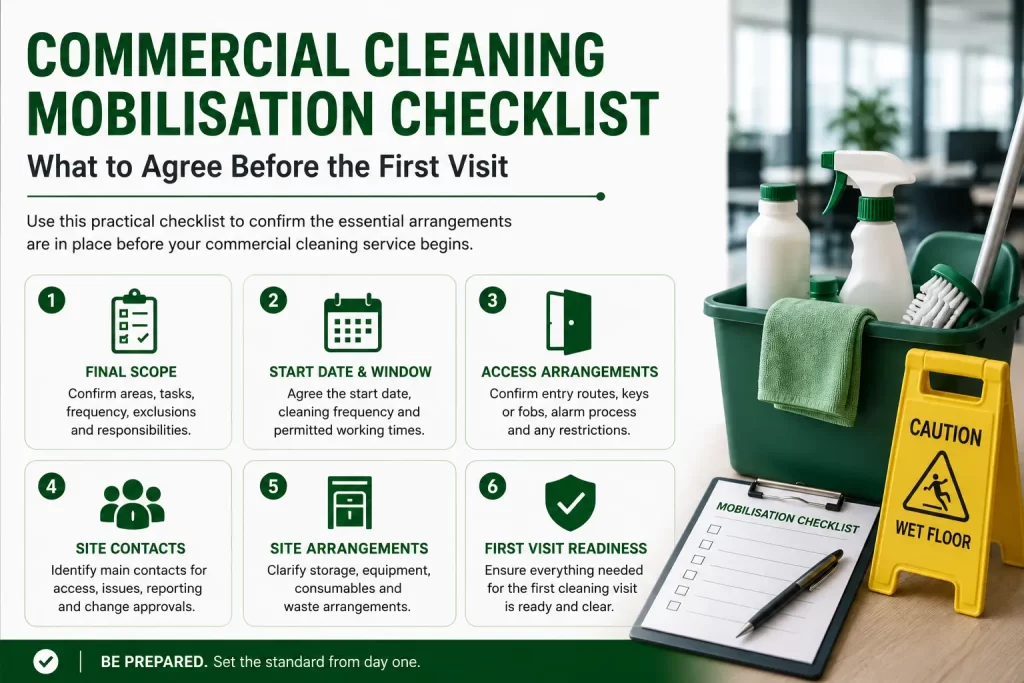
Commercial Cleaning Mobilisation Checklist: What to Agree Before the First Visit
This commercial cleaning mobilisation checklist helps facilities managers, office managers, property managers and commercial buyers turn an agreed cleaning scope into a workable first visit by confirming the final scope, start date, access, contacts and practical site arrangements.
Mobilisation happens after the cleaning requirement has been agreed and before routine delivery begins. It is the point where the buyer checks that the service can work in the real building: the correct areas are included, the cleaning window is practical, access is arranged, contacts are known and responsibilities are clear.
What Is a Commercial Cleaning Mobilisation Checklist?
A commercial cleaning mobilisation checklist is a practical launch plan used between agreeing a recurring cleaning service and starting operational delivery. It confirms the final cleaning scope, start date, frequency, permitted working window, access arrangements, site contacts, relevant supplies and waste arrangements, and the route for reporting early issues.
The site survey and mobilisation are not the same stage. The survey checks the premises and gathers information. Mobilisation checks that the agreed information has been translated into arrangements that can actually work on the first visit.
If the premises are still being assessed, use the Commercial Cleaning Site Survey Checklist first.
- Survey vs mobilisation vs quality review
- Confirm the final cleaning scope
- Agree the start date and cleaning window
- Make access work before day one
- Confirm contacts and issue reporting
- Clarify storage, consumables and waste
- Prepare for the first visit
- Review the early service
- Handle changes after launch
- Final mobilisation checklist
Where Commercial Cleaning Mobilisation Fits
The commercial cleaning mobilisation checklist owns a specific stage in the cleaning-management process. It should not duplicate the site survey or the later inspection process. Keeping the stages separate makes it easier for a facilities team to understand which questions belong before appointment, which arrangements belong before launch and which checks belong after the service is running.
1. Site survey
Checks the building, areas, usage, surfaces, access conditions and current cleaning priorities before the final requirement is confirmed.
2. Mobilisation
Turns the agreed cleaning requirement into workable access, timing, contact and site arrangements for the first operational visits.
3. Quality review
Checks the live service against the agreed requirement and identifies recurring issues, corrective actions and changes that need review.
Simple distinction: the survey discovers what the service must account for. Mobilisation makes sure the agreed service can actually start.
Start the Commercial Cleaning Mobilisation Checklist With the Final Scope
A commercial cleaning mobilisation checklist should start with the final agreed scope, not the earliest version of the enquiry. Details can change after a site survey, quotation discussion or internal review. Before the first visit is planned, confirm that the areas, tasks, frequency, working window and exclusions being launched are the version everyone has actually agreed.
Areas
- Confirm Included Floors And Rooms
- Confirm Shared Or Managed Areas
- Identify Restricted Areas
- Remove Areas No Longer Required
Routine cleaning
- Confirm Agreed Tasks
- Confirm Cleaning Frequency
- Confirm The Working Window
- Check High-Priority Areas
Scope boundaries
- Confirm Exclusions
- Identify Periodic Work
- Clarify Client Responsibilities
- Record Approved Changes
If the cleaning requirement itself is still unclear, use the Commercial Cleaning Specification Checklist before continuing.
Agree the Start Date, Frequency and Cleaning Window
The start date and the cleaning window are different. The start date says when the recurring service begins. The cleaning window says when cleaners are permitted to enter and carry out the work. Both should be confirmed before launch so the agreed service fits the way the premises actually operates.
| Mobilisation point | What to confirm | Why it matters |
|---|---|---|
| Start date | The intended date when recurring cleaning becomes operational. | Gives both sides one clear launch point. |
| Cleaning frequency | The agreed visit pattern and any areas with a different frequency. | Keeps attendance aligned with the agreed requirement. |
| Working window | Whether cleaning is permitted before opening, during selected daytime periods, in the evening or within another agreed window. | Makes the cleaning plan workable around building use. |
| Periodic work | Whether non-routine cleaning needs a separate schedule or later approval. | Prevents periodic tasks being confused with routine first-visit work. |
The commercial cleaning mobilisation checklist should not promise one universal preparation period. A small straightforward workplace and a larger multi-area property may need very different amounts of preparation. The key test is whether the necessary operational details are ready before cleaning is expected to begin.
Make Access Work Before the First Visit
Access is one of the most practical parts of a commercial cleaning mobilisation checklist. A clear cleaning specification will not help if the cleaning team cannot enter the building, reach an agreed area or follow the site’s security process. Access arrangements should therefore be confirmed before the first cleaner is due to arrive.
Entering the premises
- Reception Or Concierge Entry
- Keys Or Access Fobs
- Contractor Sign-In
- Service Entrance Where Relevant
Security arrangements
- Alarm Process Where Relevant
- Restricted Rooms
- Lock-Up Expectations
- Relevant Keyholder Contact
If access fails
- Know Who To Contact
- Communicate Access Changes
- Clarify Restricted-Area Approval
- Update Changes To Site Hours
Practical rule: do not wait until the first cleaner is outside the building to discover how entry is supposed to work.
Confirm Site Contacts, Issue Reporting and Change Approvals
A commercial cleaning mobilisation checklist should establish a simple communication route. The provider needs to know who can answer practical building questions, while the buyer needs to know where to raise access problems, missed tasks or changes to the cleaning requirement.
| Contact need | Question to resolve |
|---|---|
| Main site contact | Who understands the day-to-day building arrangements and can answer practical questions? |
| Access issue | Who should be contacted if cleaners cannot enter or reach an agreed area? |
| Cleaning issue | How should a missed task or operational problem be reported? |
| Scope change | Who can approve a permanent change to areas, tasks, frequency or timing? |
| Building change | Who needs to know when occupancy, opening hours, security or access conditions change? |
For the wider operational points around an ongoing recurring service, see the Commercial Cleaning Contract Checklist .
Clarify Storage, Equipment, Consumables and Waste
Not every site needs the same storage, supply or waste arrangements. The commercial cleaning mobilisation checklist should therefore ask what is relevant to the actual premises instead of assuming every cleaning contract operates in the same way.
Storage and equipment
- Is Suitable Storage Available If Required?
- Are Any Storage Areas Restricted?
- Is Relevant Utility Access Available?
- Are There Rules About Equipment Movement?
- Must Anything Be Removed After Each Visit?
Consumables and waste
- Who Supplies Relevant Consumables?
- Who Handles Restocking?
- Where Are Internal Waste Points?
- Where Should Collected Waste Be Taken?
- Are Any Waste Streams Managed Separately?
These questions clarify responsibility; they do not mean every item is automatically included in a LitMex cleaning service. What is provided should match the agreed cleaning scope for the premises.
Keep Relevant Site Safety Information Clear
Mobilisation should also confirm site information that affects how cleaning can be carried out, such as restricted areas, busy pedestrian routes or working-time limitations. This is an operational check rather than a replacement for site-specific professional safety assessment.
Official reference: the Health and Safety Executive guidance on cleaning and slip risks explains why cleaning methods, timing and pedestrian access need to be considered around wet-floor conditions.
What Should Be Ready for the First Cleaning Visit?
The first visit is where the commercial cleaning mobilisation checklist becomes operational. The aim is to remove avoidable uncertainty while still allowing genuine site details to be refined once the service is running.
Confirm the basic arrangements
The date, cleaning window, access route, relevant keys or fobs, site contact and known restrictions should already be understood.
Resolve remaining site questions
If a short operational walkthrough is needed, use it to confirm practical matters such as storage, waste routes or restricted areas rather than reopening the whole cleaning specification.
Watch for assumptions that do not work
The first visit may reveal that an area is inaccessible at the expected time, a route is busier than anticipated or a task needs clarification. Record the issue instead of allowing an unclear workaround to become the permanent routine.
Capture anything that needs adjusting
Confirm access problems, scope gaps or operational changes and decide whether each issue was a one-off event or whether the agreed service needs updating.
Review the Early Service Before Small Problems Become Routine
A commercial cleaning mobilisation checklist should include an early review, but there is no reason to invent one universal review date for every premises. The useful question is whether the first visits have confirmed that the agreed scope, access and working arrangements are practical.
Scope check
- Were All Expected Areas Accessible?
- Were Any Tasks Unclear?
- Was Anything Missing From The Scope?
- Did Periodic Work Need Clarification?
Operational check
- Did Entry Work As Planned?
- Was The Cleaning Window Practical?
- Did Storage Arrangements Work?
- Was The Waste Route Clear?
Communication check
- Were Issues Reported Clearly?
- Were The Correct Contacts Used?
- Were Agreed Changes Recorded?
- Are Repeat Problems Emerging?
Once cleaning is operating normally, move into ongoing quality management with the Commercial Cleaning KPIs and Inspection Checklist .
Handle Site Changes After the Cleaning Service Starts
Commercial premises change. Teams move, opening hours are adjusted, new areas are occupied and access procedures are updated. The commercial cleaning mobilisation checklist should therefore establish how changes will be communicated instead of assuming the launch arrangement will remain correct indefinitely.
| Change | What to review |
|---|---|
| New or closed area | Confirm whether the cleaning scope needs to be updated before the new arrangement becomes routine. |
| Different opening hours | Check whether the existing cleaning window remains practical. |
| Access or alarm update | Update the relevant access arrangement before the next affected visit. |
| Higher occupancy | Review whether the cleaning frequency still reflects how the premises is being used. |
| New cleaning requirement | Clarify whether it belongs inside the existing scope or requires a separately agreed change. |
Change control in plain English: identify what changed, clarify responsibility and record what was agreed rather than relying on an informal assumption.
Commercial Cleaning Mobilisation Checklist Before the First Visit
Use this final commercial cleaning mobilisation checklist to confirm that the main operational arrangements are ready before a recurring commercial cleaning service begins.
| Check | Question to confirm |
|---|---|
| Final scope | Are the agreed areas, tasks, frequency and boundaries the final version being launched? |
| Start date | Is the operational service start date clear? |
| Cleaning window | Is it clear when cleaning may take place? |
| Access | Are reception, sign-in, keys, fobs, alarms and restricted areas understood where relevant? |
| Site contact | Is there an appropriate person for practical building questions? |
| Issue reporting | Does the facilities team know how to report an operational or cleaning issue? |
| Change approval | Is it clear who can approve permanent changes to the cleaning requirement? |
| Storage | If storage is required, is the arrangement appropriate and understood? |
| Consumables | Where relevant, is supply and restocking responsibility clear? |
| Waste | Is the relevant internal waste route understood? |
| First visit | Does everyone know what needs to be ready when operational cleaning starts? |
| Early review | Is there a clear route for identifying and resolving initial operational issues? |
Final readiness test: the first visit should not depend on the cleaning team discovering the scope, entry route, contacts and site arrangements for themselves.
Continue Through the Commercial Cleaning Management Process
Mobilisation connects the agreed scope to live service delivery. These related guides cover the stages before and after the first visit.
Preparing a Commercial Cleaning Mobilisation Checklist in London?
Use this commercial cleaning mobilisation checklist to confirm the practical details that should be ready before the first visit, including the final scope, timing, access arrangements, site contacts and relevant responsibilities.
LitMex provides commercial-only cleaning across London for offices, managed properties and business premises. Tell us about your site, cleaning frequency and access requirements to discuss your cleaning service.
Related Commercial Cleaning Services

Commercial Cleaning Mobilisation Checklist FAQs
These answers cover the practical transition from agreeing a commercial cleaning service to getting the first operational visits running.
What is a commercial cleaning mobilisation checklist?
A commercial cleaning mobilisation checklist is a practical list of arrangements to confirm between agreeing a cleaning service and beginning operational delivery. It can cover final scope, start date, cleaning frequency, permitted working times, access, site contacts and relevant first-visit arrangements.
When does commercial cleaning mobilisation happen?
Commercial cleaning mobilisation happens after the cleaning requirement has been agreed but before the service is expected to operate normally. Its purpose is to turn the agreed scope into practical arrangements for the first cleaning visits.
How far in advance should cleaning mobilisation start?
There is no single mobilisation period that suits every commercial cleaning service. The preparation required depends on the size and complexity of the premises, access arrangements, cleaning scope and other site-specific requirements. The essential arrangements should be ready before operational cleaning begins.
What should be confirmed before the first cleaning visit?
Confirm the final cleaning scope, operational start date, visit frequency, permitted cleaning window, building access, relevant site contacts and any applicable storage, consumable or waste arrangements that affect the service.
Who provides keys and access information?
The buyer should identify the appropriate person or building-management route for confirming access arrangements. Depending on the site, this may involve reception, security, a facilities contact, keys, fobs, sign-in procedures or another agreed access process.
Should the cleaning scope be checked again during mobilisation?
Yes. Mobilisation is a useful point to confirm that the areas, tasks, frequency, working window, exclusions and responsibilities being launched are the final agreed version, particularly if details changed after the site survey or quotation.
How should changes be handled after the first visit?
If the first visits reveal a change in access, building use, scope or another operational detail, identify the issue, clarify responsibility and record any agreed change rather than allowing an informal workaround to become the permanent routine.
Who should report problems during the first cleaning visits?
The buyer should have an appropriate operational contact or reporting route for initial problems. Reports are more useful when they identify the area, task and specific issue rather than giving a general comment about cleaning quality.
What should be checked during the first month of cleaning?
Useful early review points include whether access works as planned, whether the cleaning window is practical, whether the agreed areas and tasks are clear, whether scope gaps have appeared and whether recurring issues need a more formal review.
What happens after the mobilisation stage?
Once the service is operating, the focus shifts to checking quality against the agreed cleaning requirement, recording issues and reviewing recurring problems. The LitMex Commercial Cleaning KPIs and Inspection Checklist covers that next stage.