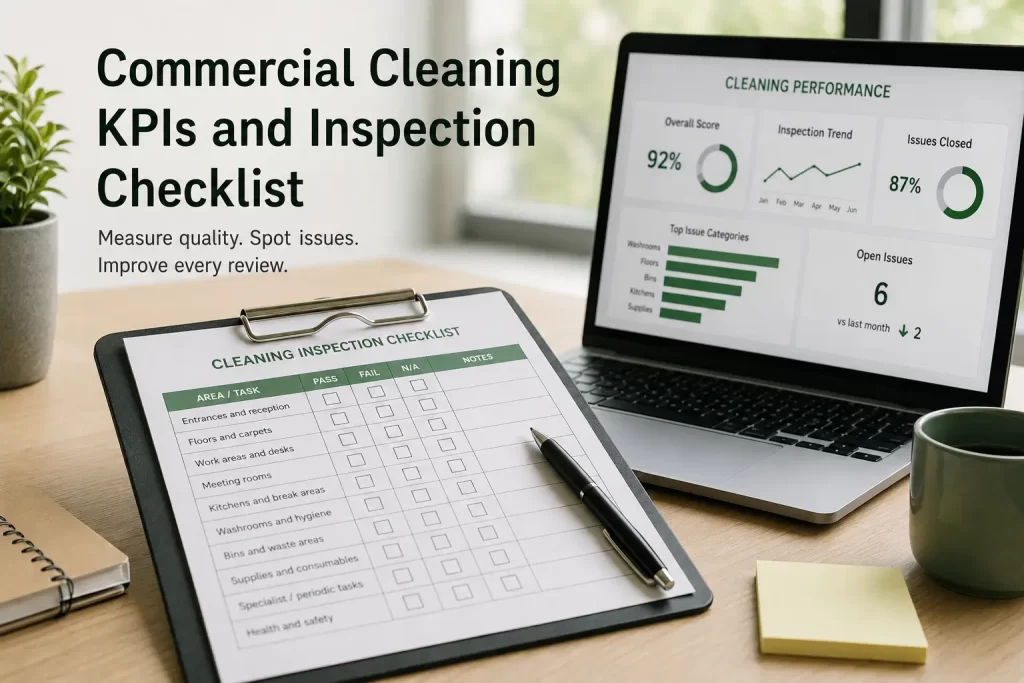
Commercial Cleaning KPIs and Inspection Checklist: How to Measure Quality
This commercial cleaning KPIs and inspection checklist helps facilities managers, office managers and property managers turn an agreed cleaning specification into practical quality reviews that show what is working, what needs attention and what should happen next.
Cleaning quality is difficult to manage when the only evidence is a complaint or a general impression that a site “looks fine”. A useful measurement system starts with the agreed scope, checks the parts of the building that matter, records findings consistently and follows problems through to closure. The aim is not to create the biggest possible dashboard; it is to make performance easier to understand and improve.
What Should a Commercial Cleaning KPIs and Inspection Checklist Measure?
A commercial cleaning KPIs and inspection checklist should measure performance against the current cleaning specification. Useful measures can include agreed task completion, the condition of high-priority areas, issue response, repeat problems, consumables where included, periodic-task completion and the quality of inspection records.
The key is to separate four things: the KPI is what you measure; the service target is the agreed level for that measure; the inspection is how you check actual conditions; and corrective action is what happens when the result needs attention. Those four parts create a usable quality loop.
There is no single percentage, inspection frequency or response time that automatically fits every commercial site. Measures and targets should reflect the actual premises, cleaning scope, occupancy, operating conditions and priorities.
- Start with the cleaning specification
- KPI, target, inspection and corrective action
- How to choose useful cleaning KPIs
- Make measures site-specific
- Build a repeatable inspection method
- What the inspection record should contain
- Close the corrective-action loop
- Separate one-off misses from recurring problems
- Build a useful service-review agenda
- Final buyer checklist
Start With the Cleaning Specification, Not a Generic Score
The strongest commercial cleaning KPIs and inspection checklist starts with the agreed cleaning specification. If the inspection is not checking the same areas, tasks and frequencies that the service is supposed to deliver, the resulting score can look precise while measuring the wrong thing.
Specification
Defines which areas, tasks, frequencies and responsibilities form the cleaning requirement.
Inspection
Checks whether actual site conditions and completed work match that requirement.
Review
Uses the findings to identify trends, corrective actions, scope changes and future priorities.
Useful principle: a cleaning score should be traceable back to something the buyer and provider have actually agreed.
If the underlying scope still needs work, use the Commercial Cleaning Specification Checklist first.
KPI vs Service Target vs Inspection vs Corrective Action
The terms are related, but they do different jobs. Keeping them separate makes a commercial cleaning KPIs and inspection checklist easier to understand and prevents one audit percentage from becoming the whole quality-management system.
What you measure
A KPI is a measurable aspect of performance, such as task completion, issue response or inspection results.
The agreed level
A target is the expected result for a KPI where the buyer and provider have agreed one.
How you check
An inspection compares actual conditions with the agreed cleaning requirement and records what was found.
What happens next
Corrective action identifies what needs putting right, who needs to address it and how completion will be verified.
Example: “issue response time” may be the KPI. The agreed response expectation is the target. A report or inspection identifies the issue, and the corrective action records how it is resolved.
Choose KPIs That Answer Real Facilities-Management Questions
A commercial cleaning KPIs and inspection checklist should be selective. Current cleaning guides often publish long KPI lists and fixed benchmark percentages, but more metrics do not automatically create better oversight. Each KPI should answer a question that the facilities team genuinely needs to manage.
| Possible measure | What it tells you | Buyer question |
|---|---|---|
| Agreed task completion | Whether scheduled routine or periodic work has been completed. | Are the tasks in the current specification actually happening? |
| Priority-area condition | Whether high-use or customer-facing areas meet the agreed expectation. | Are the areas people notice most being maintained appropriately? |
| Issue response | How reported problems move from notification to action. | Are issues acknowledged, acted on and closed in the agreed way? |
| Repeat issues | Whether the same problem continues to return. | Are we fixing the underlying cause or repeatedly treating the symptom? |
| Consumables where included | Whether agreed stock and restocking responsibilities are being met. | Is a supply problem being mistaken for a cleaning problem? |
| Periodic work | Whether non-routine tasks happen when planned. | Are periodic requirements being lost between routine visits? |
| Record quality | Whether inspection and issue records are useful enough for follow-up. | Can someone understand what happened without relying on memory? |
A small group of measures is often easier to maintain and act on than a dashboard filled with numbers that nobody reviews. The commercial cleaning KPIs and inspection checklist should help the buyer make decisions, not simply generate reports.
Use Four Questions Before Adding Any KPI
Before adding a measure, test whether it can support a real management decision. This keeps the commercial cleaning KPIs and inspection checklist buyer-focused rather than turning it into a supplier dashboard full of figures.
1. What are we trying to verify?
Link the KPI to an agreed task, condition, response route or service outcome.
2. Where will the evidence come from?
Decide whether the measure comes from an inspection, service record, issue log or another agreed source.
3. Who reviews the result?
A measure has limited value if nobody is responsible for understanding trends or exceptions.
4. What happens when it moves?
Define what should trigger clarification, corrective action or a review of the cleaning scope.
Make the Commercial Cleaning KPIs and Inspection Checklist Site-Specific
The framework can be consistent across a portfolio, but the priorities should reflect each building. An office, warehouse, managed building, retail premises and hospitality site can all have different high-use areas, operating windows and presentation requirements.
| Premises type | Examples of site-specific inspection priorities |
|---|---|
| Office | Entrances, washrooms, kitchens, meeting rooms, shared routes, floors and other high-use workplace areas. |
| Managed building | Entrances, corridors, lifts, stairs, communal routes, bin areas and recurring tenant concerns where relevant. |
| Warehouse | Operational floors, welfare areas, entrances and other areas included in the agreed scope. |
| Retail | Customer-facing floors, entrances, washrooms and high-footfall areas included in the service. |
| Hospitality | Front-of-house areas, washrooms, floors, customer routes and other explicitly agreed areas. |
For managed buildings, see Property Management Cleaning .
Build an Inspection Method That Can Be Repeated
A useful commercial cleaning KPIs and inspection checklist needs a repeatable method. The exact scoring format can vary, but the inspector should know which areas are being checked, what “meets requirement” means, how exceptions are recorded and what happens when a problem is found.
BICSc describes its cleaning and hygiene audit as a site inspection supported by review of documentation, equipment and staff practices, and lists the cleaning specification and schedule among the required inputs. That supports a simple buyer principle: quality checks should be tied to a defined scope rather than a vague impression.
Industry reference: BICSc cleaning and hygiene audits .
Do You Need a Universal Cleaning Audit Percentage?
No. Many current commercial-cleaning guides publish example thresholds such as 85%, 90% or 95%, but those numbers are not automatically the right target for every contract. A commercial cleaning KPIs and inspection checklist is stronger when the buyer first defines the requirement, measurement method and agreed target for the actual site.
BSI lists BS EN 13549:2001 as a current British Standard covering basic requirements and recommendations for quality measuring systems for cleaning services. The useful takeaway is not that every building must use one universal percentage; it is that cleaning quality can be managed through a defined measurement system.
Standards reference: BSI: BS EN 13549 cleaning-services quality measuring systems .
What Should the Cleaning Inspection Record Contain?
A score on its own is difficult to act on. The commercial cleaning KPIs and inspection checklist should capture enough context to show what was checked, where the issue occurred and what follow-up is needed.
Identify
- Site Or Area
- Inspection Date
- Relevant Task Or Requirement
- Actual Observation
Classify
- Meets Requirement
- Needs Attention
- Outside Existing Scope
- Possible Repeat Issue
Follow up
- Required Action
- Relevant Owner Or Contact
- Current Status
- Completion Verification
Photos can be useful for selected failures or recurring issues, but they should not become an automatic requirement for every check. The buyer should consider site rules, privacy, sensitivity of the area and whether a photograph adds useful evidence.
Close the Loop With Corrective Action
Finding a problem is not the end of an inspection. A commercial cleaning KPIs and inspection checklist should make it clear how an observation becomes an action and how the buyer knows the action has been completed.
| Step | Buyer question |
|---|---|
| Log | Is the area, task and actual problem recorded clearly? |
| Clarify | Is this a cleaning failure, a scope gap or a changed site condition? |
| Agree action | What needs to happen next and who is responsible for follow-up? |
| Verify | How will completion be checked? |
| Review | Is this isolated, or is the same issue starting to repeat? |
Important: a repeated failure is not always solved by asking for the same task again. If the problem keeps returning, review the frequency, access, building use and original cleaning scope.
Separate One-Off Misses From Recurring Cleaning Problems
The commercial cleaning KPIs and inspection checklist should help facilities teams see trends rather than treating every complaint as an unrelated event. One missed detail may require a simple correction. The same issue returning in the same area may point to a wider service, scope or site-use problem.
Possible delivery problem
- Same Agreed Task Repeatedly Missed
- Corrective Action Not Closed
- Repeated Condition Failure In One Area
- Problem Returns Immediately After Correction
Possible scope or site problem
- Occupancy Has Increased
- Frequency No Longer Matches Use
- Access Prevents The Agreed Task
- A New Requirement Was Never Added To Scope
If complaints are already becoming a recurring management issue, read the LitMex guide on how to reduce office cleaning complaints .
How Often Should Cleaning Quality Be Inspected?
There is no single inspection frequency that is correct for every contract. The appropriate cadence depends on the cleaning frequency, site complexity, occupancy, priority areas, previous performance and the buyer’s reporting needs. A commercial cleaning KPIs and inspection checklist should make the cadence explicit without pretending that one schedule fits all buildings.
New or changed service
Early checks can confirm whether the agreed scope, access and operating assumptions work in practice.
Stable routine service
Use a consistent cadence that is frequent enough to identify trends without creating unnecessary administration.
Recurring problem
Targeted follow-up may be appropriate until the corrective action has been verified and the pattern has stopped.
The Government Property Agency describes workplace-service performance as being managed against contract-agreed KPIs and SLAs, with feedback through regular or ad hoc meetings. That reinforces the principle that measurement and review arrangements should be agreed for the contract rather than assumed.
Official FM reference: Government Property Agency Workplace Services catalogue .
Turn Inspection Data Into a Useful Service Review
The commercial cleaning KPIs and inspection checklist should feed into a review that asks what changed and what needs action. A monthly meeting can suit some contracts, but the cadence should match the individual service rather than being presented as a universal rule.
Performance
- Inspection Findings
- Open Corrective Actions
- Repeat Issues
- Relevant Task Completion
Building changes
- Occupancy Changes
- New Or Closed Areas
- Access Changes
- Changed Operating Hours
Forward planning
- Periodic Cleaning
- High-Use Periods
- Scope Adjustments
- Measures That Need Refining
If the cleaning service has only just started, the Commercial Cleaning Mobilisation Checklist covers the launch and first-visit stage.
The wider recurring-service questions are covered in the Commercial Cleaning Contract Checklist .
Commercial Cleaning KPIs and Inspection Checklist for Buyer Reviews
Use this final commercial cleaning KPIs and inspection checklist to test whether your measurement system is connected to the cleaning requirement and produces useful follow-up rather than just another score.
| Check | Question to ask |
|---|---|
| Current specification | Are we measuring against the current agreed scope? |
| KPI purpose | Does each KPI answer a genuine service-management question? |
| Measurement method | Is it clear where the evidence comes from and how the result is calculated? |
| Targets | Are targets agreed for this service rather than copied from another building? |
| Priority areas | Are the areas that matter most to building users represented? |
| Inspection method | Are checks consistent enough to compare findings over time? |
| Evidence | Do records identify the area, requirement and actual issue clearly? |
| Corrective action | Is there a clear route from finding a problem to verifying the fix? |
| Repeat issues | Can the review distinguish recurring problems from one-off misses? |
| Site changes | Have changes in occupancy, access or scope affected the original requirement? |
| Periodic work | Are non-routine tasks being tracked separately where relevant? |
| Review outcome | Does the review end with clear decisions or actions? |
Final test: when a KPI changes, the facilities team should understand what changed, why it matters and what should happen next. A number that produces no useful decision is unlikely to be a useful KPI.
Complete the Commercial Cleaning Management Journey
This commercial cleaning KPIs and inspection checklist is the review stage of the cluster. The earlier guides help define the service, clarify the recurring arrangement and prepare the first operational visits.
Reviewing a Commercial Cleaning KPIs and Inspection Checklist?
A useful commercial cleaning KPIs and inspection checklist starts with a clear cleaning scope and focuses on measures that genuinely matter to the premises rather than generic targets copied from another building.
LitMex provides commercial-only cleaning across London for offices, managed properties and other business premises. Tell us about your current cleaning arrangement, the areas that need regular attention and the problems you want the service to address.
Related Commercial Cleaning Services

Commercial Cleaning KPIs and Inspection Checklist FAQs
What is a KPI in a commercial cleaning contract?
A cleaning KPI is a measurable aspect of service performance. It can cover task completion, inspection results, issue response, recurring problems, periodic work or another agreed measure that helps the buyer understand whether the cleaning requirement is being delivered.
What is the difference between a cleaning KPI and a service target?
The KPI is what you measure. The target is the agreed level for that measure where one has been set. Keeping those concepts separate makes the commercial cleaning KPIs and inspection checklist easier to manage and prevents the target itself from being mistaken for the measurement method.
How often should commercial cleaning quality be inspected?
There is no single inspection frequency that suits every site. The appropriate cadence depends on the cleaning frequency, site complexity, priority areas, previous performance and buyer requirements. The schedule should be consistent enough to identify trends and support useful follow-up.
Should every commercial site use the same KPI targets?
No. A consistent framework can help across multiple sites, but the measures and targets should reflect the cleaning scope, building use and priorities of each premises rather than being copied automatically from another contract.
What should a commercial cleaning inspection record?
A useful record should identify the site or area, relevant task or requirement, date, actual observation, whether attention is needed and the follow-up action. It should contain enough context for another person to understand what happened without relying on memory.
What happens when a cleaning inspection identifies an issue?
Record the issue clearly, establish whether it is a cleaning failure, a scope gap or a changed site condition, agree the appropriate corrective action and then verify that the action has been completed.
Are cleaning complaints useful as a KPI?
Complaints can be a useful signal, particularly when they are grouped by area or issue type, but they should not be the only measure of quality. Inspections can identify problems before building users need to complain.
What if the same cleaning issue keeps returning?
A recurring issue should trigger a wider review. The cause may be repeated delivery failure, but it may also indicate that cleaning frequency, access arrangements, building use or the original scope no longer matches the premises.
Can the same KPI framework be used across multiple commercial sites?
Yes. A portfolio can use a common structure for reporting, but each site should retain measures and priorities relevant to its own cleaning scope and operating conditions. This keeps comparison possible without pretending every building is identical.
How does a commercial cleaning KPIs and inspection checklist connect with mobilisation?
Mobilisation prepares the cleaning service to start by confirming scope, access, contacts and first-visit arrangements. Once the service is operating, a commercial cleaning KPIs and inspection checklist helps the buyer review delivery, record issues, track patterns and decide what needs action.