
A restaurant cleaning checklist for opening and closing shifts helps staff start the day in a clean, service-ready environment and finish the day with the restaurant properly reset for tomorrow. The best checklist covers front of house, back of house, washrooms, food-contact surfaces, floors, bins, and manager sign-off points so nothing important gets missed between shifts.
If you are building a restaurant cleaning checklist for opening and closing shifts, the goal is not only to keep the venue tidy. It is to protect hygiene standards, improve shift handovers, reduce missed tasks, and make sure the restaurant opens and closes in a controlled, professional way.
That matters because opening and closing routines solve different problems. Opening cleaning is about readiness, presentation, and food-safe setup before guests arrive. Closing cleaning is about deeper reset work, waste control, grease and residue management, and leaving the next team with a clean starting point instead of extra recovery work.
A strong restaurant cleaning checklist for opening and closing shifts turns daily cleaning into a proper system. Instead of relying on memory, rushed habits, or whoever happens to be on duty, the restaurant gets repeatable standards that are easier to manage and easier to improve.
Why a Restaurant Cleaning Checklist for Opening and Closing Shifts Matters
Restaurants do not need the same cleaning priorities at every stage of the day. Before opening, the focus is on presentation, readiness, washrooms, high-touch surfaces, and making sure food-prep areas are clean and controlled. At closing, the focus moves to full reset work, floor cleaning, waste removal, grease-heavy areas, equipment wipe-downs, and leaving the venue ready for the next shift.
A restaurant cleaning checklist for opening and closing shifts helps reduce the usual problems that build up in busy hospitality settings, such as unfinished closing tasks, inconsistent washroom standards, missed prep-area cleaning, messy staff handovers, and opening teams losing time fixing the previous shift’s mistakes.
It also helps managers hold teams to a clearer standard. A checklist creates accountability because staff know what has to be cleaned, supervisors know what needs checking, and the restaurant can keep cleaner routines even when service is fast or staffing changes.
What Should Be Cleaned Before Opening
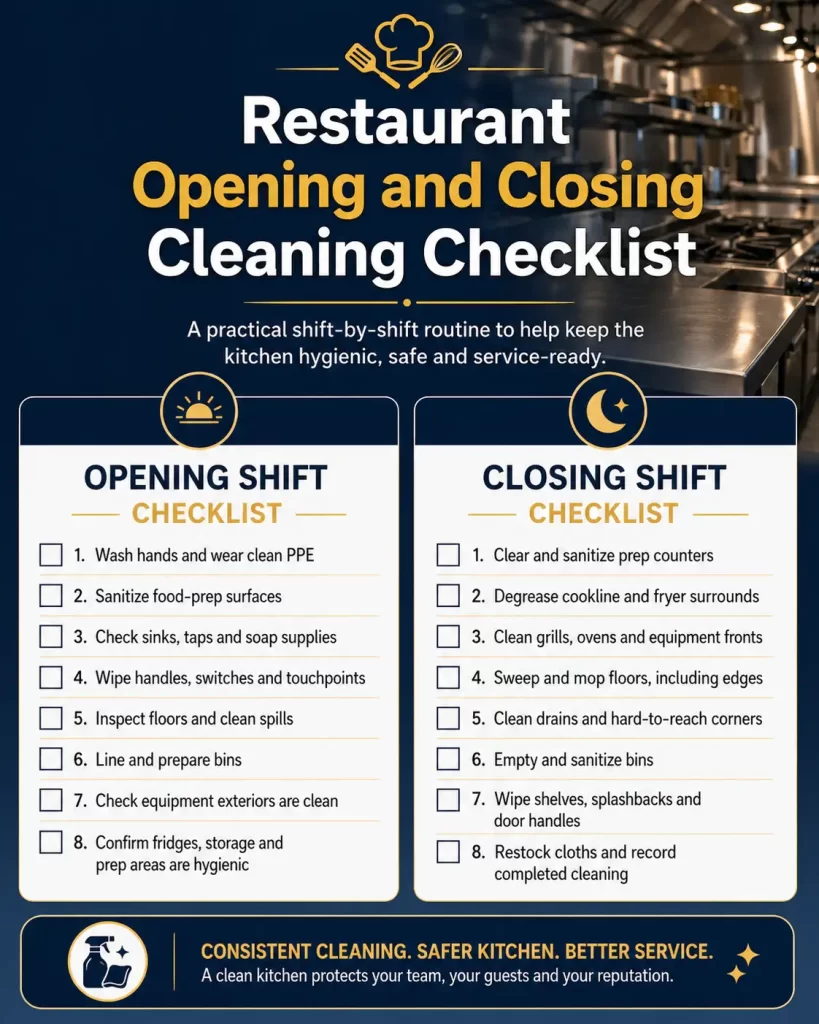
The opening shift should never begin from guesswork. Staff should know exactly what must be cleaned before service starts, and managers should know what must be checked before the restaurant is ready to welcome guests.
FOH Opening Cleaning Checklist
Front-of-house opening cleaning should focus on the spaces guests see first and touch most often.
Typical FOH opening cleaning tasks include:
- Wiping and sanitising tables, chairs, booths, and other seating surfaces.
- Cleaning host stands, counters, menus, payment points, and service stations.
- Checking entrance glass, door handles, and nearby high-touch areas.
- Spot-cleaning visible floor areas, corners, and walkways.
- Making sure customer washrooms are clean, stocked, and ready for use.
- Resetting condiment points, side stations, and other guest-facing surfaces.
- Emptying or refreshing bins where needed and checking for presentation issues.
BOH Opening Cleaning Checklist
Back-of-house opening cleaning should focus on food safety, prep readiness, and making sure the kitchen begins the day in a controlled condition.
Typical BOH opening cleaning tasks include:
- Sanitising prep counters, pass areas, chopping stations, and food-contact surfaces.
- Checking sinks, handwash stations, soap, paper towels, and sanitiser availability.
- Inspecting cooking-line areas for leftover grease, residue, or missed closing tasks.
- Checking floors, corners, and lower-level buildup in active kitchen areas.
- Wiping refrigeration handles, reachable shelves, and frequently touched storage points.
- Making sure bins, waste points, and utility areas are ready for use.
- Confirming opening prep starts in a clean and organised kitchen.
Manager Opening Checks
Managers should not rely only on assumptions that everything looks fine. Opening checks should include:
- A quick FOH walk-through.
- A quick BOH walk-through.
- Washroom condition check.
- Prep-area cleanliness check.
- Entrance and first-impression check.
- Bin and waste-point check.
- Sign-off that the restaurant is ready for service without immediate corrective cleaning.
A strong restaurant cleaning checklist for opening and closing shifts should also line up with practical hygiene controls and the kind of structured checks shown in official Food Standards Agency opening and closing checks guidance.
| Opening Task Area | Front Of House | Back Of House |
|---|---|---|
| Surfaces | Sanitise tables, chairs, counters, menus, host stands, and customer-facing touchpoints before service starts. | Sanitise prep counters, pass areas, chopping stations, sinks, and key food-contact surfaces before food prep begins. |
| Floors | Spot-check entrance areas, walkways, waiting zones, and visible guest paths for marks, spills, and overnight dust. | Check floors, corners, and lower-level buildup around prep and cooking zones so the kitchen starts in a controlled condition. |
| Washrooms And Hygiene Points | Check customer washrooms, restock paper products, soap, and other essentials, and confirm presentation is ready for guests. | Check handwash stations, soap, paper towels, and sanitiser availability for staff before active prep begins. |
| Readiness Checks | Reset service stations, condiment points, bins, and guest-facing shelves so FOH looks clean and organised at opening. | Check cooking-line areas for missed residue, refrigeration touchpoints, waste points, and prep readiness before opening work starts. |
| Manager Sign-Off | Confirm first-impression standards, washroom condition, entrance appearance, and customer-facing readiness. | Confirm prep-area cleanliness, BOH hygiene, waste-point control, and that the opening team is not inheriting missed closing tasks. |
What Should Be Cleaned At Closing
Closing is where the restaurant either protects tomorrow’s standards or creates tomorrow’s problems. A good closing routine removes the day’s buildup, resets the venue properly, and gives the opening team a clean starting point rather than extra recovery work.
FOH Closing Cleaning Checklist
Front-of-house closing cleaning should focus on restoring visible standards and removing the wear of service.
Typical FOH closing cleaning tasks include:
- Clearing, cleaning, and sanitising all tables and chairs.
- Cleaning counters, payment points, host stands, and service stations.
- Disinfecting high-touch surfaces such as handles, menus, screens, and shared touchpoints.
- Sweeping or vacuuming visible floor areas and dealing with spills or sticky patches.
- Cleaning and resetting washrooms, including basins, toilets, mirrors, and dispensers.
- Emptying and relining bins.
- Leaving entrances, waiting areas, and customer-facing zones ready for the next day.
BOH Closing Cleaning Checklist
Back-of-house closing cleaning should go further than a quick wipe-down. It should leave the kitchen properly reset, not just visually improved.
Typical BOH closing cleaning tasks include:
- Cleaning and sanitising prep counters, chopping areas, sinks, and pass areas.
- Degreasing the cookline and surrounding splash zones.
- Cleaning ovens, hobs, grills, fryers, and reachable equipment surfaces.
- Clearing crumbs, grease, and food debris from edges, corners, and lower-level areas.
- Cleaning floors, paying attention to corners, plinths, and drain zones.
- Emptying waste, cleaning bin points, and reducing overnight odour or hygiene risk.
- Wiping refrigeration handles, seals, and reachable storage surfaces.
- Leaving the kitchen organised and ready for a clean opening start.
Manager Closing Checks
Managers should confirm that the closing team has not only cleaned what looks obvious, but also completed the work that protects the next day’s service.
Typical manager closing checks include:
- FOH visual standard check.
- BOH hygiene and reset check.
- Waste removal confirmation.
- Washroom closing condition check.
- Floor condition check.
- High-touch point check.
- Sign-off that the opening team will not need to redo missed closing tasks.
A restaurant cleaning checklist for opening and closing shifts is much stronger when the closing shift is treated as preparation for the next day, not just the end of the current one.
| Closing Task Area | Front Of House | Back Of House |
|---|---|---|
| Surfaces | Clean and sanitise tables, chairs, counters, service stations, payment points, menus, and high-touch guest-facing surfaces. | Clean and sanitise prep counters, sinks, pass areas, and equipment touchpoints while resetting the kitchen after service. |
| Equipment And Residue | Reset visible FOH equipment and remove service-related marks, spills, or presentation issues before lock-up. | Degrease the cookline, wipe reachable equipment, and remove grease, crumbs, and food debris from active work zones. |
| Floors | Sweep or vacuum visible floor areas and deal with sticky patches, spills, and tracked-in dirt from service. | Clean floors thoroughly, especially around edges, corners, plinths, and drain zones where buildup can remain overnight. |
| Washrooms And Waste | Reset washrooms fully, empty and reline bins, and leave customer areas ready for the next opening shift. | Empty waste, clean bin points, reduce odour risk, and leave BOH hygiene points ready for a clean start tomorrow. |
| Manager Sign-Off | Confirm FOH visual standards, entrance presentation, washroom condition, and that guest-facing areas are reset properly. | Confirm BOH hygiene, kitchen reset quality, waste removal, and that the opening team will not inherit unfinished cleaning work. |
Restaurant Cleaning Checklist for Opening and Closing Shifts: Key Differences
A restaurant cleaning checklist for opening and closing shifts works best when staff understand that opening and closing are not duplicates.
Opening shift cleaning is mainly about:
- Readiness.
- Presentation.
- Food-safe setup.
- Stocked and usable spaces.
- Removing any problems left overnight.
Closing shift cleaning is mainly about:
- Full reset.
- Grease and residue control.
- Waste removal.
- Deeper cleanup after service.
- Preparing the site properly for tomorrow.
The opening shift asks, “Is the restaurant ready to trade?”
The closing shift asks, “Have we left the restaurant in the right condition for the next team?”
What Should Be Checked During the Shift
One of the biggest gaps in many routines is ignoring the hours between opening and closing. A restaurant cleaning checklist for opening and closing shifts should also include during-shift checks so standards do not slip while the restaurant is busy.
During-shift checks should include:
- Washroom checks and restocking.
- Quick wipe-downs of high-touch FOH points.
- Spill response on floors and service areas.
- Monitoring bins and waste points.
- Spot-sanitising counters, service stations, and hand-contact areas.
- Checking that BOH prep surfaces stay controlled during active service.
- Making sure food-contact areas are cleaned as needed between tasks.
For sites that need more consistent day-to-day upkeep between opening and closing routines, janitorial services London can help standardise cleaning discipline across the week.
What Managers Should Sign Off Every Day
Managers should sign off more than whether the place looks clean. Daily sign-off should cover:
- FOH presentation.
- Washroom readiness.
- Food-contact surface control.
- Handwash station readiness.
- Cooking-line hygiene.
- Floor condition.
- Waste handling.
- Next-shift readiness.
This is where a restaurant cleaning checklist for opening and closing shifts becomes much more effective. It stops the checklist from being a loose list of chores and turns it into a working standards system with accountability.
When Shift Cleaning Is Not Enough
Shift cleaning is essential, but it is not always enough. Some problems build up even in sites with decent daily routines, especially where service is fast, grease-heavy, or spread across long hours.
Signs that routine opening and closing cleaning may no longer be enough include:
- Persistent grease buildup around the cookline.
- Sticky residue that returns quickly.
- Floor deterioration or slip-risk concerns in high-traffic areas.
- Repeated washroom presentation problems.
- Buildup behind equipment or in harder-to-reach BOH spaces.
- Signs that staff are maintaining appearances rather than controlling deeper hygiene pressure.
If the issue is whole-venue hygiene and presentation, a wider restaurant cleaning London service may be needed. If the main pressure is in the kitchen, a dedicated commercial kitchen cleaning London service is usually the stronger fit. Where routine cleaning is no longer enough to control buildup across the site, commercial deep cleaning London can help restore standards more thoroughly. If repeated footfall, grease transfer, or floor wear starts affecting safety and presentation, hard floor maintenance London may also be needed alongside routine shift cleaning.
Frequently Asked Questions
What should be on a restaurant cleaning checklist for opening and closing shifts?
A restaurant cleaning checklist for opening and closing shifts should cover FOH cleaning, BOH cleaning, washrooms, high-touch surfaces, floors, bins, prep surfaces, cooking-line areas, and manager sign-off tasks for both the opening and closing team.
What should staff clean before a restaurant opens?
Before opening, staff should clean and sanitise guest-facing tables, counters, menus, washrooms, prep surfaces, handwash stations, and key food-contact areas so the restaurant starts the day ready for service.
What should be cleaned at restaurant closing?
At closing, staff should reset the restaurant by cleaning and sanitising FOH surfaces, washrooms, prep areas, cooking equipment, floors, waste points, and other areas affected by service throughout the day.
Should opening and closing cleaning checklists be different?
Yes. Opening and closing checklists should be different because opening focuses on readiness and presentation, while closing focuses on reset, grease control, waste removal, and preparing the site for the next day.
Should FOH and BOH have separate cleaning tasks?
Yes. FOH and BOH should have separate cleaning tasks because the risks, surfaces, and standards are different. FOH is more presentation-led and customer-facing, while BOH is more hygiene-led and food-preparation focused.
What should managers check at opening?
Managers should check washrooms, high-touch surfaces, prep areas, bins, floors, entrances, and the overall readiness of both FOH and BOH before service begins.
What should managers check at closing?
Managers should check that the team has fully reset FOH and BOH, removed waste properly, cleaned floors and washrooms, and left the restaurant ready for the next shift rather than leaving problems behind.
Is a restaurant cleaning checklist for opening and closing shifts enough on its own?
It is essential, but not always enough on its own. Busy or grease-heavy restaurants may still need professional support when routine shift cleaning no longer controls buildup or protects standards properly.
How often should a restaurant review its opening and closing cleaning checklist?
A restaurant should review its shift cleaning checklist regularly, especially when menu type, service hours, staffing patterns, or hygiene problems change.
When should a restaurant move from shift cleaning to professional cleaning support?
A restaurant should consider professional support when daily routines are no longer controlling grease, washroom presentation, floor condition, kitchen hygiene pressure, or wider FOH and BOH standards consistently.
Final Answer
A strong restaurant cleaning checklist for opening and closing shifts should do more than list tasks. It should split FOH and BOH clearly, define what must be cleaned before service starts, define what must be reset after service ends, and show managers what needs daily sign-off. That is what turns shift cleaning into a real standards system rather than a loose routine.
If you want to compare kitchen-only cleaning, wider restaurant cleaning, and deeper hygiene support across the site, LitMex’s commercial cleaning services can help you map the right service route more clearly.