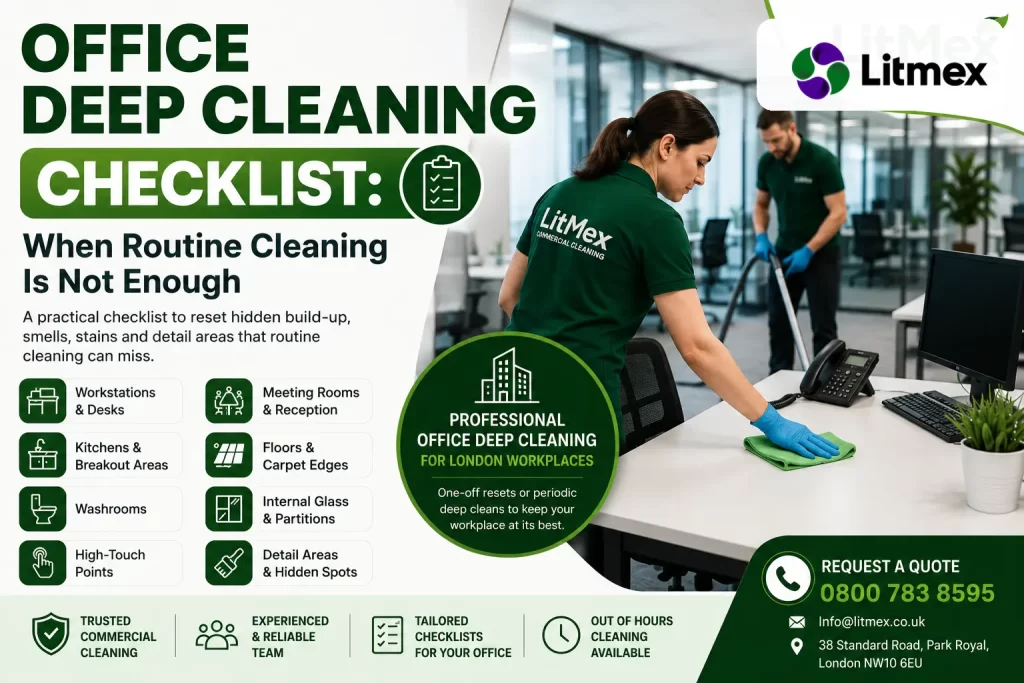
An office deep cleaning checklist helps London workplaces reset the areas that routine daily or weekly cleaning does not fully cover.
Routine office cleaning keeps desks, bins, kitchens, washrooms and floors under control. Office deep cleaning goes further, focusing on hidden build-up, smells, stains, touchpoints, carpet edges, internal glass, kitchens, washrooms and hard-to-reach areas that need periodic attention.
What Should an Office Deep Cleaning Checklist Include?
An office deep cleaning checklist should include detailed cleaning of workstations, meeting rooms, kitchens, washrooms, reception areas, high-touch points, floor edges, carpet edges, skirting boards, internal glass, shared equipment areas, door frames, corners, vents and visible areas that routine cleaning may not reach every visit.
A professional office deep clean is usually needed when regular cleaning stops restoring the workplace properly, especially where there is dust build-up, smells, stains, worn-looking washrooms, dirty carpet edges, marked kitchens or repeated staff complaints.
LitMex provides office deep cleaning in London for commercial workplaces that need a detailed reset beyond their routine cleaning schedule.
- When routine office cleaning is not enough
- Routine cleaning vs office deep cleaning comparison
- Deep-clean trigger table for office managers
- Zone-by-zone office deep cleaning checklist
- How to prepare before a professional office deep clean
- FAQs for facilities managers and London office teams
Routine Office Cleaning vs Office Deep Cleaning
Routine cleaning and deep cleaning support different needs. Routine cleaning keeps the workplace usable day to day. Office deep cleaning resets the detail areas that gradually decline even when regular cleaning is in place.
| Cleaning type | Best for | Typical focus | When it is not enough |
|---|---|---|---|
| Routine office cleaning | Keeping the office clean and usable during normal working weeks. | Bins, desks, kitchens, washrooms, floors, meeting rooms and visible touchpoints. | When corners, edges, carpets, washrooms or kitchens still look tired after cleaning. |
| Contract office cleaning | Ongoing cleaning agreements with a defined scope and frequency. | Regular workplace cleaning specification, access, timing and review points. | When the ongoing contract maintains the basics but does not include periodic reset tasks. |
| Office deep cleaning | Periodic workplace resets where routine cleaning no longer restores the standard. | Build-up, smells, stains, detail areas, edges, touchpoints, internal glass, kitchens and washrooms. | When specialist add-ons are needed, such as carpets, hard floors or high-level work. |
| Specialist periodic cleaning | Specific surfaces or cleaning methods that need separate equipment or time. | Carpets, hard floors, upholstery, windows, post-refurbishment dust or specialist floor care. | When the issue is not general deep cleaning but a specific surface problem. |
For wider one-off and periodic reset work, see commercial deep cleaning in London. For ongoing routines after the reset, see office cleaning in London.
When Routine Cleaning Is Not Enough
Routine cleaning is designed to maintain the workplace, not completely reset every detail area every visit. Even a well-managed office cleaning routine can leave gradual build-up around edges, chairs, kitchens, washrooms, internal glass and shared equipment areas.
Office deep cleaning is useful when the workplace still looks tired after normal cleaning, or when staff, visitors or managers start noticing the same cleaning problems repeatedly.
Hidden build-up
- Dust on ledges and skirting
- Dirt around chair bases
- Marks near door frames
- Carpet edges looking dark
Smells and stains
- Kitchen smells after cleaning
- Washrooms feel stale
- Bins and food areas need reset
- Carpets or floors hold marks
Return-to-office needs
- Staff returning after quiet periods
- Hybrid usage has changed
- Meeting rooms need to be client-ready
- Workplace standards need lifting quickly
Office Deep-Clean Trigger Table
These are the clearest signs that routine office cleaning may no longer be enough and a professional office deep clean should be planned.
| Trigger | What it usually means | Deep-clean response |
|---|---|---|
| The office still feels tired after routine cleaning | Visible cleaning is happening, but detail areas are not being reset. | Plan a deep clean focused on edges, touchpoints, glass, floors and shared spaces. |
| Kitchen smells keep returning | Food waste, splash areas, appliance fronts, bins or floor edges need deeper work. | Deep clean worktops, sinks, taps, splash zones, appliance fronts and bin areas. |
| Washroom complaints continue | Routine cleaning may not be reaching corners, fixtures, cubicle areas or dispensers properly. | Detail basins, toilets, mirrors, cubicle doors, floors, dispensers and touchpoints. |
| Carpet edges or corners look dark | Dust, footfall and chair movement have built up beyond standard vacuuming. | Vacuum detail edges and assess whether office carpet cleaning is needed. |
| Meeting rooms no longer feel client-ready | Presentation areas need more than a quick table wipe and bin emptying. | Deep clean tables, chairs, glass marks, floor edges, bins and touchpoints. |
| Internal glass and partitions show marks | Shared visual surfaces are affecting the overall impression of the office. | Include internal glass touchpoints and visible marks in the deep-clean scope. |
| Staff are returning after low occupancy | Dust, stale areas and unused spaces may need a workplace reset. | Schedule a return-to-office deep clean before occupancy increases. |
| A new cleaning contract is starting | The new routine may work better if the workplace starts from a clean baseline. | Use a deep clean as a pre-contract reset before routine cleaning begins. |
Zone-by-Zone Office Deep Cleaning Checklist
A strong office deep cleaning checklist should be built around how the workplace is used. A London office with shared kitchens, hybrid desks, visitor rooms and busy washrooms will need a different scope from a small low-use office.
| Office zone | Deep cleaning tasks to include | Why this zone matters |
|---|---|---|
| Workstations and shared desks | Clean clear desk surfaces, chair bases, desk legs, shared workstation touchpoints, floor edges and visible dust around equipment where agreed. | Shared desks and daily-use workstations collect dust, marks and contact-point build-up. |
| Meeting rooms | Deep clean tables, chairs, bins, internal glass marks, presentation surfaces, floor edges and high-touch points. | Meeting rooms affect client perception and internal confidence. |
| Kitchens and breakout spaces | Detail worktops, sinks, taps, splash areas, appliance fronts, cupboard handles, tables, bins, floor edges and visible residues. | Food and drink areas quickly create smells, sticky surfaces and complaints. |
| Washrooms | Deep clean toilets, basins, taps, mirrors, cubicle doors, dispensers, floors, corners, touchpoints and visible build-up around fixtures. | Washrooms are one of the highest-complaint areas in commercial offices. |
| Reception and entrance areas | Clean reception desks, entrance floors, seating, glass touchpoints, skirting, door frames, visible marks and first-impression areas. | Visitors judge the workplace before they see the rest of the office. |
| Floors and carpets | Detail vacuum edges, spot review carpets, mop hard floors, clean corners and identify areas needing specialist carpet or floor care. | Footfall, wet weather and chair movement make floors look tired over time. |
| High-touch points | Clean door handles, push plates, light switches, access panels, lift buttons, printer areas, kitchen handles and washroom contact points. | Shared contact points are used repeatedly throughout the working day. |
| Detail areas | Clean skirting boards, corners, low-level ledges, door frames, partitions, vents and hard-to-reach visible areas. | These are the areas routine cleaning often misses because they need more time. |
Scope note: Office deep cleaning should be agreed clearly before work starts. Personal paperwork, IT equipment, restricted rooms, specialist carpets, high-level areas and external windows may need separate handling or a separate quote.
High-Touch Points to Include in an Office Deep Clean
High-touch points should already be part of regular office cleaning, but deep cleaning gives the team more time to treat repeated-contact areas properly and review the places staff use most.
Office movement areas
- Door handles
- Push plates
- Access panels
- Lift buttons
- Light switches
Shared work areas
- Meeting room tables
- Reception counters
- Printer areas
- Shared desks
- Chair arms and contact points
Kitchens and washrooms
- Kitchen taps
- Appliance handles
- Cupboard fronts
- Washroom dispensers
- Cubicle handles
When Should an Office Deep Clean Be Scheduled?
Office deep cleaning should be scheduled before the workplace visibly declines, not only after complaints become serious. Many London offices use deep cleaning as a planned quarterly, six-monthly or annual reset.
| Best time to deep clean | Why it helps |
|---|---|
| Before staff return after quiet periods | The office feels refreshed before occupancy increases. |
| After office moves or layout changes | Dust, marks and hidden areas can be reset before normal use resumes. |
| Before client visits or inspections | Reception, meeting rooms and washrooms can be brought up to a stronger presentation standard. |
| After refurbishment or contractor activity | Dust and residue often need more than routine office cleaning. |
| When complaints keep returning | Recurring issues may need a deeper reset before routine cleaning can maintain them. |
| Quarterly, six-monthly or annually | Periodic planning stops deep cleaning being left until standards visibly decline. |
| Before a new cleaning contract starts | A reset gives the ongoing cleaner a better baseline to maintain. |
| After heavy seasonal footfall | Wet weather, commuting dirt and busy periods can affect floors, carpets and entrances. |
For ongoing cleaning after a reset, contract office cleaning in London can help keep the workplace maintained with a clear recurring specification.
What HSE Guidance Means for Office Deep Cleaning
Office deep cleaning should support a clean, usable and properly maintained workplace. HSE workplace guidance says employers should provide clean premises, clean furniture and fittings, containers for waste materials, regular removal of dirt and waste, and prompt clearing of spillages.
For office managers, the practical point is simple: routine cleaning and periodic deep cleaning should work together so that washrooms, kitchens, traffic routes, workstations and shared facilities remain suitable for staff, visitors and normal workplace use.
Useful official reference: HSE workplace health, safety and welfare guidance.
How to Prepare Before an Office Deep Clean
A professional office deep clean works best when the site is ready. Clear access, agreed scope and simple staff communication can make a big difference to the result.
| Preparation step | Why it matters |
|---|---|
| Agree the cleaning scope | Everyone knows which areas, tasks and exclusions are included. |
| Choose the right cleaning time | Evening, weekend or out-of-hours work often allows better access. |
| Ask staff to clear desks | Cleaners can reach surfaces without moving personal papers or items. |
| Confirm restricted rooms | Confidential, server or locked spaces are handled correctly. |
| Share access instructions | Keys, fobs, alarms and building rules reduce missed areas. |
| Identify priority complaints | The cleaner can focus on the areas causing the biggest issue. |
| Plan waste and recycling access | Bin areas and collection points can be handled properly. |
| Separate specialist tasks | Carpets, windows, upholstery or hard floors may need separate planning. |
Office Deep Cleaning Quote Checklist
Before asking for a quote, prepare the information a cleaning provider needs to scope the work properly. This helps avoid vague pricing and missed areas.
| Information to provide | Why it helps |
|---|---|
| Office location | Helps plan travel, access and site requirements. |
| Approximate office size | Supports time and staffing estimates. |
| Number of desks and rooms | Shows how much workstation and room detail is needed. |
| Number of kitchens and washrooms | These areas usually require more detailed cleaning time. |
| Floor types | Carpet, hard floor and entrance areas may need different methods. |
| Main cleaning concerns | Helps prioritise complaints, smells, marks or build-up. |
| Preferred cleaning window | Evening, weekend or early morning timing may affect the plan. |
| Access details | Keys, fobs, alarms, lifts and restricted rooms can be planned in advance. |
| Specialist add-ons | Carpets, windows, upholstery or hard floors can be quoted separately if needed. |
| Future routine cleaning needs | A deep clean can be followed by a better ongoing cleaning schedule. |
Need an Office Deep Clean in London?
LitMex helps London offices reset tired, marked or high-use workplaces with detailed office deep cleaning for desks, kitchens, washrooms, meeting rooms, reception areas, floors, touchpoints and shared spaces.
Whether your office needs a one-off deep clean, a pre-contract reset, a staff return clean or periodic detailed cleaning alongside routine office cleaning, LitMex can help you plan the right scope.
Related Cleaning Services

FAQs: Office Deep Cleaning Checklist
What is an office deep cleaning checklist?
An office deep cleaning checklist is a detailed list of the areas and tasks that should be covered when routine office cleaning is not enough. It can include desks, kitchens, washrooms, meeting rooms, floors, carpets, internal glass, touchpoints and detail areas.
What is included in office deep cleaning?
Office deep cleaning can include detailed cleaning of workstations, meeting rooms, kitchens, washrooms, reception areas, floor edges, carpet edges, skirting boards, high-touch points, internal glass and hard-to-reach visible areas.
When is routine office cleaning not enough?
Routine office cleaning may not be enough when there is visible dust build-up, tired washrooms, kitchen smells, carpet edge dirt, repeated complaints, marked meeting rooms or detail areas that no longer feel fresh after normal cleaning.
How often should an office be deep cleaned?
Many offices schedule deep cleaning quarterly, six-monthly or annually, depending on staff numbers, footfall, kitchens, washrooms, visitor use and how well routine cleaning is maintaining the workplace.
Is office deep cleaning different from daily office cleaning?
Yes. Daily office cleaning maintains regular areas such as bins, kitchens, washrooms, desks and floors. Office deep cleaning gives more detailed attention to build-up, edges, corners, touchpoints, internal glass and areas missed by routine cleaning.
Should office deep cleaning happen out of hours?
Office deep cleaning is often easier out of hours, in the evening or at weekends because cleaners have better access to desks, kitchens, washrooms, floors, meeting rooms and shared areas without disrupting staff.
Do office carpets need to be included in a deep clean?
Carpet edges and visible floor build-up can be included in an office deep clean, but full commercial carpet cleaning may need to be planned as a specialist add-on depending on the carpet condition and cleaning method required.
Do kitchens and washrooms need extra attention during an office deep clean?
Yes. Kitchens and washrooms are high-use shared areas and often need detailed cleaning of sinks, taps, appliance fronts, dispensers, cubicle doors, corners, floors and touchpoints.
Can office deep cleaning help before a new cleaning contract starts?
Yes. A deep clean before a new contract starts can reset the workplace and give the ongoing cleaning team a better baseline to maintain with daily or scheduled office cleaning.
How do we prepare for an office deep clean?
Prepare by agreeing the scope, choosing the cleaning time, asking staff to clear desks, confirming restricted rooms, sharing access details, identifying priority complaints and separating any specialist carpet, window or floor tasks.