
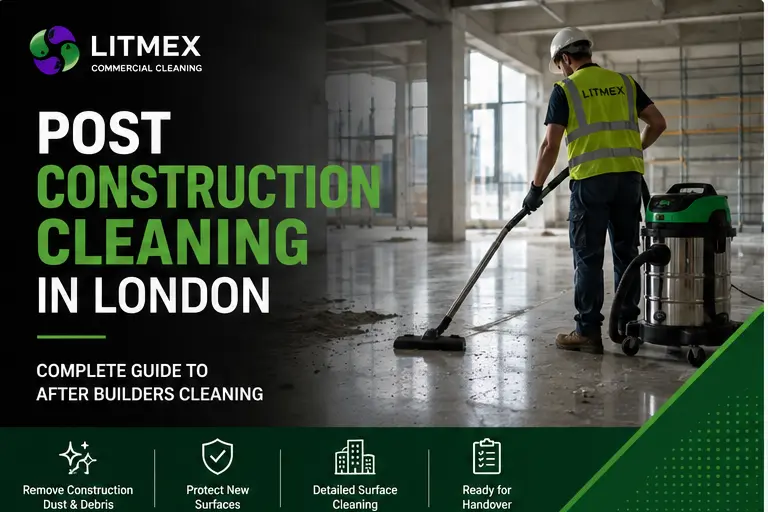
Post construction cleaning in London is the specialist cleaning carried out after building work, refurbishment, renovation, fit-out or contractor activity. It removes fine construction dust, plaster residue, paint marks, adhesive, packaging, debris and the finishing mess that normal cleaning is not designed to handle.
For commercial and managed properties, this type of clean is often the difference between a space that looks almost finished and a space that is actually ready for staff, tenants, customers, inspections, photography or handover.
At LitMex, we provide professional after builders cleaning in London for commercial premises, offices, managed buildings, retail units, hospitality spaces, clinics, showrooms and post-refurbishment projects. This guide to post construction cleaning in London explains what the service includes, why builders’ dust needs specialist handling, how the cleaning process works, what affects the cost and how to choose a reliable cleaning company.
What Is Post Construction Cleaning in London?
Post construction cleaning in London is a detailed clean carried out after construction, refurbishment, fit-out or renovation work. It focuses on removing builders’ dust, plaster residue, paint splashes, adhesive marks, packaging, debris and fine dust from surfaces, fixtures, glass, floors and hard-to-reach areas.
This service is not the same as regular office cleaning. A regular cleaning visit is designed to maintain a space that is already in use. Post construction cleaning is designed to recover a property after disruptive work has taken place.
It is also different from end of tenancy cleaning. End of tenancy cleaning usually focuses on occupancy-related dirt, limescale, appliances, bathrooms, kitchens and general wear. Post construction cleaning focuses more on plaster dust, paint splashes, adhesive residue, grout haze, protective film residue, sawdust, building debris and newly installed surfaces.
You may need post construction cleaning in London after:
- Office refurbishment
- Commercial fit-out
- Shop or showroom installation
- Restaurant, café or bar renovation
- Clinic or healthcare refurbishment
- Managed property maintenance works
- New flooring, decoration or partitioning
- Building repairs after leaks, damage or structural work
- End-of-project handover from contractors
The main goal is simple: make the site clean, safe, presentable and ready for use.
Post Construction Cleaning vs After Builders Cleaning vs Sparkle Cleaning
Post construction cleaning, after builders cleaning and sparkle cleaning are closely related, but they are not always the same. Post construction cleaning is the wider term, after builders cleaning is the common UK service phrase, and sparkle cleaning is usually the final detailed clean before handover, reopening or occupation.
Post construction cleaning can refer to cleaning after any construction or refurbishment project, from a small office update to a full commercial fit-out.
After builders cleaning is the common UK phrase. When people search for after builders cleaning London, they usually need help removing dust, plaster residue, paint splashes and general mess after contractors have finished.
Sparkle cleaning is usually the final finishing stage. It is more detailed and presentation-led. A sparkle clean may happen after the main builders clean, once dust has settled and snagging work is complete. It is often used before photography, client handover, tenant move-in, staff return or opening day.
For larger commercial projects, one clean is not always enough. A staged approach may work better:
- Initial builders clean after major works
- Detail clean after snagging
- Final sparkle clean before handover or opening
This is especially useful for offices, retail spaces, hotels, hospitality venues, clinics and managed buildings where appearance matters from the first day back in use.
What Does Post Construction Cleaning in London Include?
Most post construction cleaning in London includes dust removal, surface cleaning, floor cleaning, internal glass and frame cleaning, fixture detailing and removal of visible builders’ residue. The exact scope depends on the property type, the amount of dust, the surfaces involved and the condition of the site.
A professional post construction clean may include:
- Removing fine dust from horizontal and vertical surfaces
- Cleaning skirting boards, doors, frames and architraves
- Cleaning internal windows, glass panels, frames and sills
- Removing paint splashes where safe and practical
- Removing plaster residue and light surface marks
- Cleaning switches, sockets, handles and touchpoints
- Vacuuming floors with suitable equipment
- Mopping hard floors after dust extraction
- Cleaning newly fitted kitchens, bathrooms or washrooms
- Cleaning inside cupboards, shelves and storage areas where agreed
- Removing labels, protective film and adhesive residue where safe
- Cleaning staircases, corridors, lifts and entrance areas
- Clearing light packaging or loose debris where included in the quote
For commercial premises, the work may also include reception areas, meeting rooms, staff kitchens, washrooms, corridors, stairwells, back-of-house areas, treatment rooms, shop floors, display spaces or communal areas.
For deeper specialist work, LitMex can connect the clean with relevant services such as commercial deep cleaning, commercial window cleaning London, commercial carpet cleaning London and hard floor maintenance London.
What Is Usually Excluded?
A good post construction cleaning company should be clear about exclusions before work begins. This protects the customer, the cleaning team and the newly finished surfaces.
Post construction cleaning may not automatically include:
- Heavy construction waste removal
- Hazardous waste removal
- Asbestos-related cleaning
- External high-level window cleaning
- Specialist stone restoration
- Floor sanding or refinishing
- Severe paint or cement removal from delicate surfaces
- Cleaning unsafe or incomplete work areas
- Moving heavy contractor materials
- Cleaning areas without safe access, lighting or water
Light debris and packaging may be included if agreed. Larger rubbish removal may require separate waste handling. For commercial waste, businesses should check that waste is handled legally and that any waste carrier used is properly registered. You can check official guidance on managing business and commercial waste on GOV.UK.
The safest approach is to ask for a written scope before the clean begins. That way, the customer knows what is included, the cleaning team understands the site conditions and there is less risk of disagreement after the work is complete.
Why Post Construction Cleaning in London Needs Specialist Methods
Post construction cleaning in London needs specialist methods because builders’ dust is fine, persistent and easily spread. It can settle inside corners, vents, window tracks, skirting edges, cable points, cupboards, sockets, floor joints and newly installed fixtures. Wrong cleaning methods can also damage fresh finishes.
Construction dust is different from normal office dust. It can be much finer, heavier and more persistent. The Health and Safety Executive explains that construction dust is not just a nuisance and can be a risk to lungs. You can read the HSE’s official information about construction dust risks.
That does not mean every finished refurbishment is dangerous to occupy, but it does show why dust control and cleaning methods matter. Simple dry wiping or dry sweeping can make the problem worse. Fine dust can become airborne again and resettle after the cleaner leaves.
That is why professional post construction cleaning should follow the right sequence: remove larger debris first, extract fine dust, clean from high to low, then finish floors and details last.
Specialist cleaning is also important because new surfaces can be vulnerable. Fresh paint, new flooring, glass, brushed metal, stainless steel, stone, tiles, joinery and sealants can all be damaged by the wrong chemical, abrasive pad or scraping method.
A careful cleaning team should think about:
- The type of residue
- The surface material
- The safest removal method
- Whether the mark can be removed without damage
- Whether specialist treatment is needed
- Whether the area is ready to clean or still part of live works
The aim is not just to clean quickly. The aim is to remove builders’ dust and residue without damaging the finished work.
The Typical Post Construction Cleaning Process
A good post construction cleaning process should follow a planned order. The usual sequence is site assessment, debris control, high-to-low dust removal, surface detailing, floor cleaning and final inspection. This prevents dust from being moved around the property and helps the site reach a better handover standard.
1. Site assessment and scope
Before cleaning starts, the team should understand the property, the work completed, the surfaces involved and the deadline. For a commercial project, this may include access times, parking, lifts, loading bays, security procedures and whether contractors are still on site.
The quote should confirm what is included, what is excluded and whether the clean is one-off or phased.
2. Initial debris and dust control
The team removes loose dust, light debris and surface-level mess first. Larger waste, leftover materials and contractor rubbish should be separated from cleaning tasks, especially if separate waste removal is needed.
This stage prepares the property for more detailed cleaning.
3. High-to-low dust removal
Professional cleaners usually work from higher areas downwards. This means dust from ledges, frames, shelving, light fittings, vents and vertical surfaces is removed before floors are finished.
This sequencing matters because dust falls. Cleaning the floor first and then wiping higher surfaces wastes time and can leave the site looking dusty again.
4. Surface and detail cleaning
Once the main dust has been controlled, the team works through details such as doors, handles, skirting boards, switches, sockets, glass, frames, sills, fitted units, washroom fixtures, kitchen areas and touchpoints.
This is where a builders clean starts to look different from a basic clean. The detail work removes the signs of construction activity that make a finished space feel unfinished.
5. Floor cleaning
Floors are usually cleaned late in the process. Depending on the surface, this may involve vacuuming, mopping, machine cleaning, spot treatment or more specialist hard floor care.
Different floors need different methods. Vinyl, tile, wood, stone, carpet and safety flooring should not all be treated the same way.
6. Final inspection
The final step is checking the site against the agreed scope. For commercial handovers, this may include reception areas, washrooms, meeting rooms, shop floors, corridors, stairwells and customer-facing areas.
If the project has ongoing snagging, the final inspection should also identify areas likely to need another detail clean later.
Post Construction Cleaning in London Checklist
Use this post construction cleaning in London checklist to understand what should be cleaned before a commercial space is handed over, reopened or occupied. The final scope should always reflect the property type, surface condition, access restrictions and level of builders’ dust.
General areas
- Dust removed from accessible surfaces
- Skirting boards cleaned
- Door frames and handles cleaned
- Switches and sockets wiped carefully
- Window sills and frames cleaned
- Internal glass cleaned where included
- Floors vacuumed and mopped
- Visible paint or plaster marks treated where safe
- Cupboards, shelves and storage areas cleaned where agreed
- Rubbish and packaging removed where included
- Final touchpoints checked
Office and commercial spaces
- Reception desks and counters cleaned
- Meeting rooms dusted and finished
- Desk areas cleaned before occupation
- Cable points and floor boxes cleaned carefully
- Partitions and glass panels cleaned
- Staff kitchen surfaces cleaned
- Washrooms cleaned and checked
- Corridors and stairwells cleaned
- Lift doors and touchpoints wiped
- Floor edges and corners checked for dust
For offices, see also office cleaning London and office after builders cleaning London.
Retail and showroom spaces
- Shop floor dust removed
- Display areas cleaned
- Glass, mirrors and frames cleaned
- Fitting rooms or consultation rooms cleaned
- Counters and payment areas cleaned
- Entrance doors and handles cleaned
- Flooring cleaned for customer presentation
- Back-of-house areas cleaned if included
For showroom-related cleaning, LitMex also provides car dealership and showroom cleaning.
Hospitality and food premises
- Front-of-house areas cleaned
- Bar or counter areas cleaned
- Dining areas dusted and finished
- Customer washrooms cleaned
- Staff areas cleaned where included
- Kitchen cleaning planned separately if deeper hygiene work is needed
- Floors cleaned with suitable methods
For food premises, see restaurant cleaning London and commercial kitchen cleaning London.
Clinics and healthcare-style premises
- Reception and waiting areas cleaned
- Consultation rooms dusted and wiped
- Touchpoints cleaned carefully
- Washrooms cleaned
- Floors cleaned according to surface type
- High-dust areas checked before opening
- Waste scope clarified separately
For healthcare-related commercial premises, see healthcare cleaning and clinic deep cleaning London.
What Affects the Cost of Post Construction Cleaning in London?
The cost of post construction cleaning in London depends on the size of the property, level of dust, type of building work completed, surface sensitivity, access arrangements, number of cleaners required, timing and any add-on services such as carpet cleaning, hard floor care or waste removal.
Property size
A larger office, retail unit, restaurant, clinic or managed building will usually need more cleaners, more time and more equipment. Square footage matters, but layout also matters. A small property with many rooms, fittings, glass partitions or detailed surfaces can take longer than a larger open-plan space.
Dust level
Fine plaster dust, sawdust and construction dust can settle repeatedly. If the site has not had a rough clean, the professional clean may take longer. If contractors are still working, dust may resettle after the first clean.
Type of building work
Light redecoration creates a different cleaning load from a full refurbishment. Flooring work, sanding, plastering, tiling, joinery, partitioning and ceiling works can all create different types of residue.
Surface sensitivity
Newly installed finishes often need careful treatment. Natural stone, polished floors, glass, stainless steel, specialist tiles and painted joinery may require slower cleaning methods to avoid damage.
Access and logistics
London projects can be affected by parking, loading, congestion, building access, security, lift availability, out-of-hours work and time restrictions. A central London office clean after a fit-out may need different planning from a Park Royal warehouse or a West London managed block.
Timing
Urgent cleans, evening work, weekend work and pre-handover deadlines may affect planning and price. If the project needs a staged builders clean and final sparkle clean, that should be quoted clearly.
Add-on services
Some projects need extra services such as carpet cleaning, hard floor maintenance, high-level cleaning, window cleaning, kitchen deep cleaning or waste removal. These should be priced separately or clearly included in the quote.
A reliable company should not guess blindly. They should ask questions, request photos or arrange an assessment where needed.
Post Construction Cleaning in London by Property Type
Different properties need different cleaning priorities. A strong plan for post construction cleaning in London should match the building, the surfaces, the deadline and how the space will be used after the work is complete.
Property type: Offices, meeting rooms and shared workspaces.
Main cleaning priorities: Dust removal, desks, meeting rooms, glass partitions, kitchens, washrooms, corridors and floor edges.
Common risks: Fine dust in cable points, floor boxes, vents, skirting edges, corners and newly fitted fixtures.
Best time to book: After contractors finish major works and before staff return, client visits or office handover.
Property type: Shops, showrooms and customer-facing units.
Main cleaning priorities: Shop floor dust removal, display areas, mirrors, entrance glass, counters, changing rooms and customer touchpoints.
Common risks: Visible dust under bright lighting, adhesive marks, poor first impression and residue near display areas.
Best time to book: Before stock loading, merchandising, photography, soft launch or reopening.
Property type: Restaurants, cafés, bars and hotels.
Main cleaning priorities: Front-of-house areas, bar counters, dining spaces, guest areas, customer washrooms, fixtures and floors.
Common risks: Dust near food-service areas, residue on new fittings, floor marks and poor customer presentation.
Best time to book: Before reopening, with any kitchen deep cleaning planned separately where required.
Property type: Private clinics, dental practices and healthcare-style premises.
Main cleaning priorities: Reception areas, waiting rooms, consultation rooms, touchpoints, washrooms, flooring and fitted surfaces.
Common risks: Fine dust on new surfaces, poor patient impression, sensitive fixtures and high-touch areas needing careful cleaning.
Best time to book: Before reopening, before final setup and before patient-facing areas are used again.
Property type: Blocks, communal areas and landlord-managed spaces.
Main cleaning priorities: Lobbies, corridors, stairwells, lifts, entrance areas, bin stores, handrails and communal touchpoints.
Common risks: Dust spreading through shared access routes, resident complaints and dirty handover areas.
Best time to book: After refurbishment or repair works and before resident handover or managing agent inspection.
Property type: Newly fitted business premises.
Main cleaning priorities: Open-plan areas, washrooms, staff kitchens, glass, floors, fixtures, final presentation and handover details.
Common risks: Dust resettling after snagging, rushed handover, residue on new finishes and missed detail areas.
Best time to book: Often in phases: main builders clean first, then final sparkle clean before handover.
Tip: For commercial projects, post construction cleaning in London is easier to plan when the cleaning company knows the property type, access times, contractor schedule, surface finishes and handover deadline before quoting.
How to Choose a Post Construction Cleaning in London Provider
The best provider for post construction cleaning in London is not always the cheapest one. The right company should understand builders’ dust, commercial deadlines, access issues, surface risk, insurance, communication and handover pressure.
Before booking, ask these questions:
Do they have experience with post construction cleaning?
A regular cleaning company may be good at maintenance cleaning but inexperienced with builders’ dust, adhesive residue, plaster marks, grout haze and newly finished surfaces.
Ask whether they regularly clean after refurbishment, fit-out or contractor work.
Are they clear about what is included?
A vague quote can lead to disputes. Ask whether the quote includes glass, frames, cupboards, floors, washrooms, kitchens, light debris, internal windows, high-level dusting or specialist marks.
The scope should be written clearly.
Do they understand surface risk?
Paint splashes, plaster marks and adhesive residue cannot always be removed aggressively. A careful company should explain when removal is safe, when testing is needed and when specialist treatment may be required.
Can they work around London access restrictions?
For many London properties, cleaning is not just about labour. It is also about logistics. Parking, loading, building security, lift access, out-of-hours cleaning and contractor schedules can all affect the job.
Are they insured?
Insurance is important because post construction cleaning often takes place around new finishes, expensive fixtures and deadline-sensitive spaces.
Do they follow professional cleaning standards?
Professional cleaning should be planned, consistent and measurable. For extra credibility, you can review the British Institute of Cleaning Science information about industry cleaning standards.
Do they offer commercial cleaning support after handover?
For offices, retail premises, managed buildings, hospitality spaces and clinics, the post construction clean may only be the first step. Once the space reopens, ongoing commercial cleaning services may be needed to keep it presentable.
LitMex provides commercial cleaning support across London, including office cleaning, property management cleaning, retail cleaning, hospitality and hotel cleaning and commercial fit-out cleaning London.
Red Flags to Avoid
Post construction cleaning in London happens at an important stage of a project. A poor clean can delay occupation, create complaints, damage surfaces or leave the space looking unfinished.
Be careful if a provider:
- Gives a price without asking about size, condition or scope
- Cannot explain what is included
- Treats post construction cleaning like a basic one-size-fits-all clean
- Does not ask about surfaces or finishes
- Promises to remove every mark without inspecting it
- Does not clarify waste removal
- Has no process for access, timing or handover
- Cannot provide commercial cleaning experience
- Avoids questions about insurance
A reliable provider should ask about the site, the surfaces, the level of dust, the deadline and the result you need. For offices, clinics, showrooms, hospitality premises and managed buildings, the clean should be planned around the commercial use of the space.
When Should You Book Post Construction Cleaning in London?
The best time to book post construction cleaning in London is after the main building work is complete, once contractors have removed tools and major materials, but before the space is occupied, stocked, photographed or handed over.
For planned refurbishments, post construction cleaning in London should be arranged before the final handover date. For larger or more detailed projects, a staged clean is often better than trying to complete everything in one visit.
Book before handover
If the property needs to be ready for inspection, tenant arrival, client walkthrough or staff return, do not leave cleaning until the final day. London projects can be affected by access, traffic, parking, contractor delays and snagging work.
Booking early gives time to plan the scope and schedule.
Allow for snagging
Snagging can create more dust. If contractors return after the main clean to sand, drill, patch, paint or adjust fittings, the space may need another detail clean afterwards.
This is why some projects need a final sparkle clean after snagging.
Plan around stock, furniture and equipment
For offices and retail premises, it is usually easier to clean before desks, furniture, stock, display units or equipment are fully installed. Once items are in place, dust can be trapped behind and underneath them.
Where possible, clean after messy work but before final setup.
Can a Regular Cleaner Do Post Construction Cleaning?
A regular commercial cleaner may help with light dusting after minor work, but proper post construction cleaning usually needs different equipment, sequencing and attention to surface risk.
The problem is not just visible dirt. Fine construction dust can settle again after cleaning. Paint, plaster, adhesive and grout residue may also need careful treatment. Using the wrong method can scratch glass, dull flooring, damage new paint or mark delicate finishes.
For commercial premises, it is usually safer to book a specialist after builders cleaning team, especially if the space is being handed over to tenants, staff, customers or inspectors. That is why many businesses arrange post construction cleaning in London before reopening, handover or staff return.
How Long Does Post Construction Cleaning Take?
The time needed for post construction cleaning in London depends on the size of the property, dust level, number of rooms, surface types, access, cleaning scope and whether contractors have fully finished. A small commercial unit may take several hours, while larger projects may need a full day or multiple visits.
A small commercial unit after light refurbishment may take several hours. A larger office, restaurant, clinic, showroom or managed property may need a full day or multiple visits. A staged clean may be needed if dust continues to settle or contractors return for snagging.
The best way to estimate time is to provide:
- Property type
- Approximate size
- Number of rooms or floors
- Photos of the condition
- Type of building work completed
- Deadline or handover date
- Access restrictions
- Any specialist surfaces or concerns
This helps the cleaning company plan the right number of cleaners and avoid underestimating the job.
Post Construction Cleaning in London FAQs
What is post construction cleaning in London?
Post construction cleaning in London is the specialist clean carried out after building work, refurbishment, renovation or fit-out. It removes builders’ dust, plaster residue, paint marks, adhesive, debris and finishing mess so the property is ready for use, handover or occupation.
Is post construction cleaning the same as after builders cleaning?
In London, the terms are often used in a similar way. After builders cleaning is the common service phrase, while post construction cleaning is a broader term. Both usually refer to removing dust and residue after building or refurbishment work.
What does after builders cleaning include?
After builders cleaning usually includes dust removal, surface cleaning, internal glass and frame cleaning, floor cleaning, washroom and kitchen cleaning, touchpoint cleaning and removal of light builders’ residue where safe. The exact scope should be agreed before the clean.
Does post construction cleaning remove paint splashes?
Light paint splashes may be removable, depending on the surface and paint type. A professional cleaner should assess whether removal is safe. Aggressive scraping or chemicals can damage glass, floors, metal, stone, tiles or painted surfaces.
Does it include rubbish removal?
Light packaging or small debris may be included if agreed. Heavy building waste, hazardous materials or large-scale rubbish removal may need a separate waste removal service. Commercial waste should be handled responsibly and legally.
Do I need one clean or multiple cleans?
One clean may be enough after a small project. Larger refurbishments, commercial fit-outs and handover projects may need an initial builders clean, a detail clean after snagging and a final sparkle clean before opening or occupation.
Can post construction cleaning be done out of hours?
Yes, many commercial projects need cleaning outside normal working hours to avoid disruption. Access, security, parking, building rules and staffing should be confirmed before booking.
Is post construction cleaning safe for new surfaces?
It should be, if the cleaning team uses the right methods and tests carefully where needed. New surfaces can be delicate, so the cleaning company should avoid aggressive chemicals or abrasive tools unless suitable for that material.
How much does post construction cleaning in London cost?
The cost of post construction cleaning in London depends on property size, dust level, scope, surface types, access, timing and any add-on services. A reliable quote should be based on the condition of the site, not just a generic hourly estimate.
Does LitMex provide post construction cleaning in London?
Yes. LitMex provides commercial after builders and post construction cleaning in London for offices, commercial premises, managed properties, retail spaces, hospitality venues, clinics, showrooms and refurbishment projects. Visit our after builders cleaning London service page to request a quote.
Need Commercial Post Construction Cleaning in London?
If your project is nearing completion, professional cleaning should be planned before handover, opening or staff return. A well-organised post construction clean removes dust, improves presentation, protects new finishes and helps the space feel ready for use.
LitMex provides commercial post construction and after builders cleaning across London, including office refurbishments, commercial fit-outs, managed properties, retail units, hospitality spaces, clinics and showrooms.