
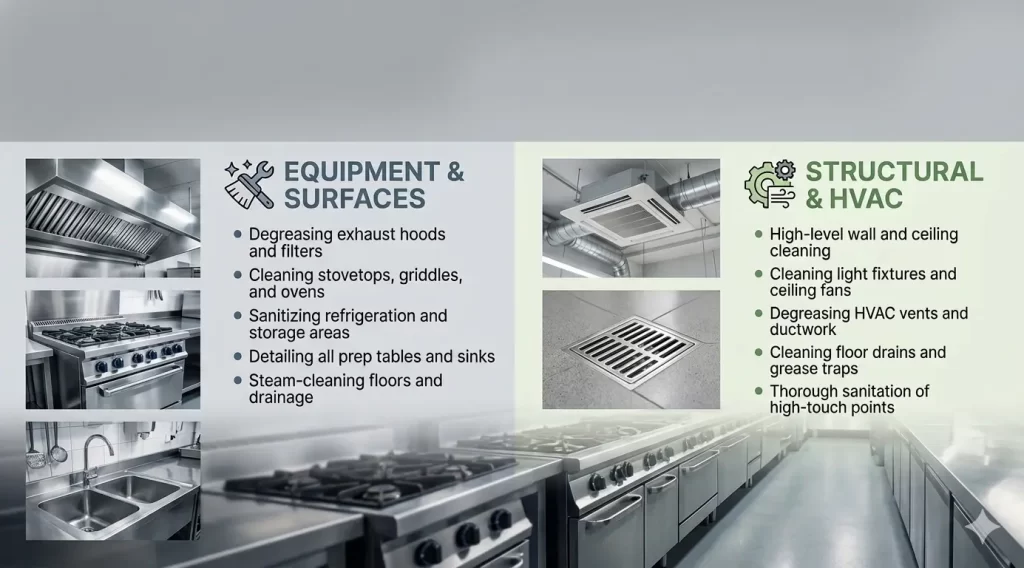
A restaurant kitchen deep clean usually includes food-prep surfaces, cooking equipment, grease-heavy zones, floors, drains, refrigeration details, hidden buildup points, and deeper sanitisation beyond routine daily cleaning. Some services also include canopy or extraction-related cleaning, while others treat that as a separate specialist item.
If you are asking what is included in a restaurant kitchen deep clean, you are usually not asking out of curiosity. You are trying to understand what a professional service should cover, what might be missing from a quote, and whether the kitchen needs more than routine staff cleaning.
That is an important distinction. Daily close-down cleaning and a proper deep clean are not the same thing. A deep clean reaches areas that are often missed during normal shifts, especially where grease, residue, food debris, and hidden buildup create hygiene, operational, and fire-risk pressure over time.
For restaurant owners, general managers, and operations teams, the most useful way to think about a deep clean is this: it is not a general wipe-down. It is a structured, more intensive cleaning service focused on the kitchen’s highest-risk and hardest-to-maintain areas.
Why a Restaurant Kitchen Deep Clean Is Different From Routine Kitchen Cleaning
Routine kitchen cleaning keeps a site operational from shift to shift. It covers the visible and immediate mess left after service: wipe-downs, quick degreasing, surface cleaning, bins, and end-of-day resets.
A deep clean goes further. It targets the areas that routine cleaning often does not fully reach or cannot maintain consistently under service pressure, especially where grease, residue, and hidden buildup create hygiene, operational, and fire-risk issues over time.
Where routine cleaning is no longer enough to control buildup, grease, and hygiene pressure, commercial deep cleaning London can support a more complete reset.
What Is Included in a Restaurant Kitchen Deep Clean?
Most professional restaurant kitchen deep cleans include the following core areas.
Food-Prep Surfaces and Sanitisation
Prep counters, worktops, splash areas, pass areas, sinks, and surrounding food-contact or food-adjacent surfaces are usually cleaned and sanitised in detail. This is one of the most important parts of the job because prep surfaces sit at the centre of day-to-day food safety, cross-contamination prevention, and practical kitchen hygiene. Food-safe cleaning routines should also support the standards set out in the Food Standards Agency’s Safer food, better business for caterers guidance.
Cooking Equipment and Appliances
A proper deep clean usually covers ovens, grills, fryers, hobs, hot plates, salamanders, and surrounding buildup areas. On many sites, this also includes trays, racks, filters, and reachable internal surfaces. Cooking equipment is one of the main areas operators expect to see clearly included in a professional deep-clean scope.
Grease-Heavy Zones
Grease-heavy zones are one of the biggest reasons restaurants book a deep clean in the first place. These areas can include wall lines near cooking equipment, splash zones, behind the cookline, around extraction-adjacent surfaces, and corners where grease settles. If these areas are ignored for too long, the kitchen may start to feel clean on the surface while hidden residue continues to build.
Floors, Drains and Lower-Level Buildup
Kitchen floors, skirting lines, corners, plinths, and lower-level edges are usually part of the standard deep-clean scope. Many providers also include drain cleaning at a practical hygiene level, although specialist drainage or blockage work may be separate. Lower-level buildup is often underestimated because it is less visible during service but has a big effect on hygiene and day-to-day standards.
Refrigeration and Storage Details
A restaurant kitchen deep clean often includes shelves, reachable internal refrigeration surfaces, seals, gaskets, and surrounding storage hygiene. These details matter because food storage hygiene is often missed when teams focus only on hot-side equipment and visible prep areas.
Behind and Under Equipment
This is one of the most valuable parts of the service. Deep cleans usually target hidden buildup behind fixed or semi-fixed equipment, under counters, around plinths, and in harder-to-reach spaces where crumbs, grease, dust, and residue collect. These are exactly the zones that daily staff cleaning often misses because of time pressure or access limitations.
Extraction, Canopy or Ventilation-Related Cleaning
Some restaurant kitchen deep cleans include light canopy and filter cleaning as part of the core scope. However, full extraction, ductwork, or TR19 Grease-aligned ventilation cleaning is often a separate specialist service rather than something automatically included in every deep-clean quote.
If your site needs a quote-stage scope review or a deeper operational reset, a dedicated commercial kitchen cleaning London service is usually the most relevant next step.
What Is Usually Included in a Restaurant Kitchen Deep Clean?
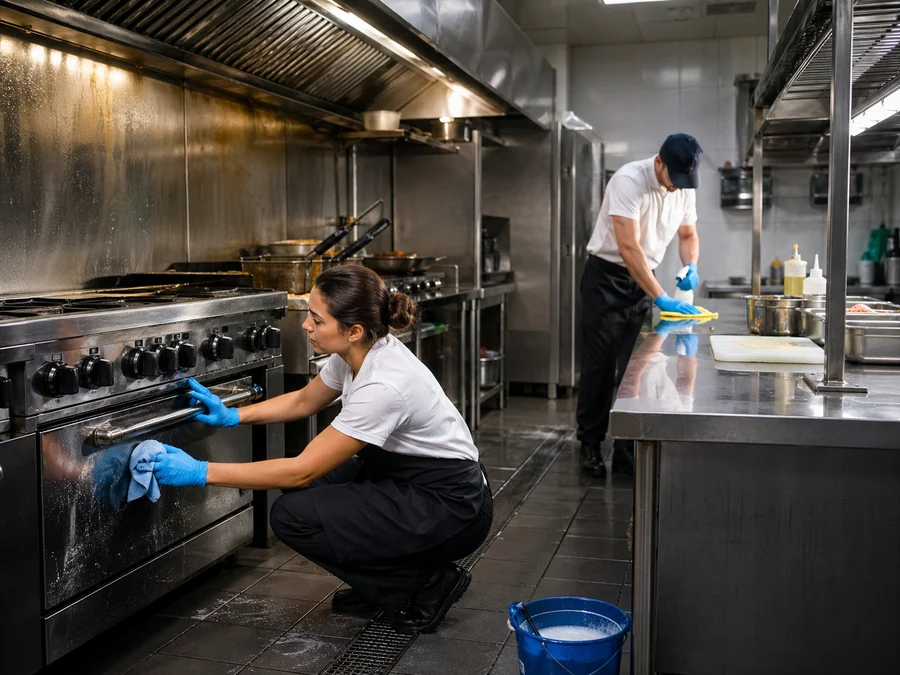
The table below shows which restaurant kitchen deep-clean tasks are usually included as standard and which items may be quoted separately depending on access, buildup, ventilation scope, and site condition.
| Area or Task | Usually Included | May Be Extra or Separate |
|---|---|---|
| Food-prep surfaces | Prep counters, worktops, splash areas, sinks, pass areas and surrounding food-contact surfaces are usually cleaned and sanitised in detail. | Specialist food-safety documentation or site-specific compliance reporting may sit outside a standard cleaning scope. |
| Ovens, grills and fryers | Most deep cleans include ovens, grills, fryers, hobs and visible surrounding buildup areas as standard kitchen equipment cleaning. | Heavy dismantling, severe carbonised buildup or restoration-level work may affect the final quote and scope. |
| Floors and drains | Kitchen floors, lower-level buildup, corners, skirting lines and practical drain cleaning are usually part of a deep clean. | Specialist blockage work, drainage repairs or separate servicing requirements may be outside the standard clean. |
| Refrigeration shelves and seals | Reachable internal surfaces, shelving, seals, gaskets and surrounding refrigeration hygiene are often included where access allows. | Full strip-out, repair work or specialist maintenance on refrigeration units may be separate. |
| Grease-heavy zones | Cooking-line areas, splash zones, wall edges, grease-prone surfaces and surrounding residue points are usually treated as core deep-clean areas. | Severe grease saturation or restoration-level degreasing can increase the scope and cost. |
| Behind and under equipment | Hidden buildup behind equipment, under counters and around fixed units is often included where access is realistic and safe. | Moving heavy appliances, specialist lifting or access restrictions may create separate charges or exclusions. |
| Extraction canopy and filters | Light canopy and filter cleaning may be included by some providers as part of the wider deep-clean scope. | Full ductwork, specialist extraction cleaning or TR19-aligned ventilation work is often quoted separately. |
| Grease traps | Some providers include practical grease-trap cleaning or basic surrounding hygiene support. | Formal grease-trap servicing, waste handling or documented specialist work is often separate. |
| Out-of-hours access | Some deep cleans are carried out outside normal kitchen operating hours where access is straightforward. | Late-night, early-morning or disruption-sensitive access may affect pricing depending on the venue and schedule. |
What Is Usually Included as Standard and What May Be Extra?
One of the biggest problems with this topic is that many pages explain the service but do not help the reader judge a quote. That is where the standard-inclusions question matters.
Most restaurant kitchen deep-cleaning services will usually include prep surfaces, cooking equipment, visible surrounding buildup, grease-heavy cooking-line areas, floors, lower-level edges, reachable drains, and hidden hygiene-sensitive zones where access is practical.
Items that may be separate or extra often include full extraction and ductwork cleaning, TR19 Grease-aligned ventilation work, grease-trap servicing, specialist drain blockage work, heavy appliance moving, severe carbonised buildup, or disruption-sensitive out-of-hours work.
What a Restaurant Kitchen Deep Clean Does Not Always Include
A kitchen deep clean does not always mean the entire restaurant is being cleaned. It does not automatically include dining areas, customer washrooms, front-of-house floors, entrance presentation, pest control, equipment maintenance, or formal extraction certification work.
If the site also needs dining-area, front-of-house, or washroom support, that usually sits under a wider restaurant cleaning London service rather than a kitchen-only deep clean.
How Often Should a Restaurant Kitchen Be Deep Cleaned?
There is no single schedule that fits every site. The right frequency depends on trading volume, cooking style, grease load, operating hours, kitchen layout, current condition, and how strong the daily routine already is.
In practice, busier and grease-heavier kitchens usually need deeper attention more often than lower-volume sites. Operators should treat deep cleaning as part of planned hygiene control rather than waiting until standards visibly slip.
What Managers Should Ask Before Approving a Quote
Before approving a restaurant kitchen deep-clean quote, ask:
- Which exact areas are included?
- Are prep surfaces and food-contact zones covered?
- Are ovens, grills, fryers, and hot-side equipment included?
- Are drains and grease-prone floor zones included?
- Are refrigeration shelves, seals, and storage areas included?
- Is behind-equipment cleaning included where access allows?
- Is canopy or extraction cleaning part of the quote?
- What is excluded?
- Will anything cost extra?
- Is the service routine deep cleaning or restoration-level cleaning?
Frequently Asked Questions
What is included in a restaurant kitchen deep clean?
A restaurant kitchen deep clean usually includes food-prep surfaces, cooking equipment, grease-heavy zones, floors, drains, refrigeration details, hidden buildup areas, and deeper sanitisation beyond routine daily cleaning. Some providers also include canopy or extraction-related cleaning, while others treat that as a separate specialist scope.
Does a restaurant kitchen deep clean include ovens, grills and fryers?
Usually yes. Ovens, grills, fryers, hobs, and other cooking appliances are some of the main items included in a professional kitchen deep clean, although heavy dismantling or severe carbonised buildup may affect the final scope and price.
Are food-prep surfaces and sinks included in a kitchen deep clean?
Yes. Prep counters, worktops, splash areas, sinks, and surrounding food-contact zones are normally included because these areas are central to food-safe cleaning and cross-contamination control.
Does a restaurant kitchen deep clean include floors and drains?
Usually yes. Most deep cleans cover kitchen floors, lower-level buildup, edges, corners, and practical drain cleaning, especially where grease and food debris collect. However, specialist blockages or drainage repairs may be treated separately.
Are grease traps included in a restaurant kitchen deep clean?
Sometimes, but not always. Grease-trap servicing is often treated as a separate specialist task depending on the provider, the system on site, and whether documentation or waste-handling requirements are involved.
Does a kitchen deep clean include extraction or ventilation cleaning?
Sometimes partly, but not always fully. Light canopy or filter cleaning may be included, while full ductwork or specialist extraction cleaning is often quoted separately.
Are refrigeration shelves, seals and storage details included?
Often yes. A proper deep clean may include refrigeration shelves, reachable internal surfaces, seals, gaskets, and surrounding storage hygiene, especially in kitchens where hidden residue and food debris build up over time.
Is cleaning behind and under equipment included in a deep clean?
Usually yes, where access allows. One of the main reasons operators book a deep clean is to remove hidden buildup behind equipment, under counters, around plinths, and in harder-to-reach spaces that are often missed during routine shift cleaning.
How is a restaurant kitchen deep clean different from daily kitchen cleaning?
Daily cleaning keeps the kitchen operational. A deep clean is more detailed and targets buildup, hidden areas, and hygiene pressure points that routine close-down cleaning often does not fully resolve.
How often should a restaurant kitchen be deep cleaned?
There is no single frequency that fits every site. It depends on trade volume, cooking style, grease load, operating hours, and current kitchen condition. In practice, busier and grease-heavier kitchens usually need deeper attention more often than lower-volume sites.
How long does a restaurant kitchen deep clean usually take?
It depends on the kitchen size, level of buildup, number of appliances, access conditions, and whether the quote includes extras like extraction or heavy degreasing. Smaller kitchens may be completed much faster than large, heavily used sites, especially where out-of-hours work is required.
What should I ask before approving a restaurant kitchen deep-clean quote?
Ask exactly what is included, what is excluded, whether equipment interiors are covered, whether behind-equipment cleaning is included, whether extraction or grease-trap work is separate, and whether severe buildup or out-of-hours access changes the price.
Final Answer
If you are asking what is included in a restaurant kitchen deep clean, the best answer is this: a proper deep clean usually covers prep surfaces, equipment, grease-heavy zones, floors, drains, refrigeration details, hidden buildup points, and deeper sanitisation beyond routine daily cleaning. Some providers also include canopy or extraction-related work, but full TR19 or specialist ventilation cleaning may sit outside the standard scope.
Businesses comparing kitchen-only cleaning with wider support can also review LitMex commercial cleaning services to see how kitchen, restaurant and deep-cleaning routes fit together.