
Restaurant cleaning vs restaurant kitchen cleaning is a common comparison for operators who need to understand whether they need whole-venue cleaning, kitchen-only cleaning, or both. The difference between restaurant cleaning and restaurant kitchen cleaning is simple: restaurant cleaning covers the wider venue, while restaurant kitchen cleaning focuses on the food-prep and cooking environment.
Most busy venues need both, but they solve different problems. One supports presentation and customer-facing standards, and the other targets hygiene-critical back-of-house areas.
When people search for the difference between restaurant cleaning and restaurant kitchen cleaning, they are usually trying to answer a practical question before booking a service: do they need a full-venue clean, a kitchen-only clean, or both?
That matters because the two scopes overlap, but they are not interchangeable. A restaurant can look clean from the dining room and still have grease, residue, and hygiene pressure building up in the kitchen. On the other hand, a kitchen can be cleaned properly while the front of house, washrooms, entrances, and customer-facing touchpoints still let the venue down.
For restaurant owners, operations managers, and hospitality teams, the right answer is usually not choosing one instead of the other forever. It is understanding what each service includes, what each one is for, and when a business needs both at the same time.
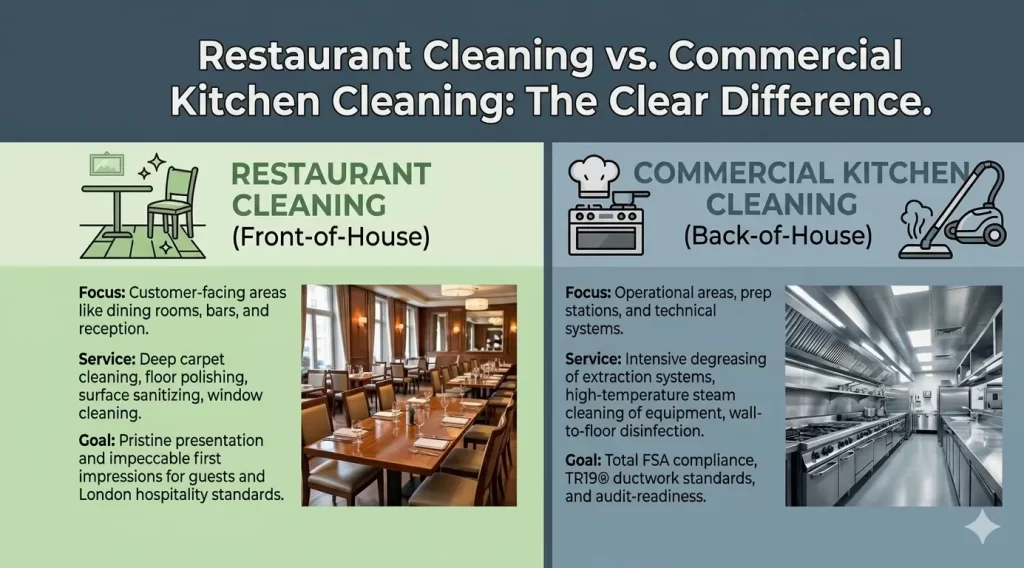
Why the difference matters
A lot of cleaning discussions blur the line between whole-restaurant cleaning and kitchen-only cleaning. That creates confusion because the priorities are different.
Restaurant cleaning is wider. It supports the appearance, cleanliness, and day-to-day presentation of the venue as a whole. It includes the spaces customers see, the spaces staff move through, and the areas that affect overall standards.
Restaurant kitchen cleaning is narrower but often more intensive. It focuses on the kitchen itself rather than the entire restaurant. That means surfaces, equipment, splash zones, sinks, extraction-adjacent areas, grease-heavy points, and the detailed buildup that accumulates behind the scenes.
So if you are comparing restaurant cleaning vs restaurant kitchen cleaning, the easiest way to think about it is this:
- Restaurant cleaning = the wider venue
- Restaurant kitchen cleaning = the working kitchen environment
What restaurant cleaning usually includes
Restaurant cleaning usually covers the full venue beyond just the cookline or prep zone. The goal is to keep the business clean, presentable, safe to use, and consistent for customers and staff throughout trading hours.
Dining areas
Tables, chairs, floors, skirting lines, visible dust, marks, touchpoints, and general presentation all matter in customer-facing spaces. Even small issues are noticed quickly in busy hospitality environments.
Entrances and circulation areas
Door glass, handles, thresholds, waiting areas, host stands, walkways, and visible floor areas shape first impressions. These areas often collect dirt faster than teams expect.
Washrooms
Washrooms influence the overall impression of hygiene across the whole venue. A clean kitchen does not fully protect the brand if the customer washrooms are let down.
Front-of-house touchpoints
Menus, counters, payment points, hand-contact surfaces, bar fronts, ledges, and service-facing areas often need consistent routine attention.
Back-of-house non-kitchen spaces
Storage corridors, staff routes, delivery access points, staff washrooms, and utility areas may also fall under broader restaurant cleaning depending on the agreed scope.
General floor care
Floors across the venue, not just in the kitchen, often need different cleaning methods based on use, finish, and traffic level.
In short, restaurant cleaning is about the full operating environment of the venue, especially where presentation, customer experience, staff movement, and day-to-day standards all meet.
What restaurant kitchen cleaning usually includes
Restaurant kitchen cleaning is more focused and usually more technical in practice. It is centered on the kitchen itself rather than the entire restaurant. Food-safe cleaning routines should also support the standards set out in the Food Standards Agency’s Safer food, better business for caterers.
Food-prep surfaces
Prep counters, worktops, splash areas, pass areas, sinks, and surrounding food-contact surfaces need thorough cleaning and controlled hygiene standards.
Cooking equipment
Ovens, hobs, grills, fryers, salamanders, hot plates, extraction-adjacent surfaces, and surrounding buildup zones often need more than a normal wipe-down.
Grease-prone areas
Grease is one of the biggest differences between restaurant kitchen cleaning and wider restaurant cleaning. Once grease accumulates, the kitchen may require deeper attention than routine staff cleaning can realistically deliver during service pressure.
Hard-to-reach zones
Behind equipment, under counters, edges, corners, plinths, wall lines, and service voids often collect dust, crumbs, grease, and residue that are not always handled during routine end-of-shift cleaning.
Storage and utility points
Shelving, dry storage areas, under-sink zones, bin areas, small equipment storage, and utility spaces may be part of a kitchen-focused cleaning scope.
Periodic deep-clean elements
In many cases, restaurant kitchen cleaning includes periodic deep cleaning rather than only light routine cleaning. That can mean more detailed attention to neglected or high-risk areas that sit outside everyday wipe-down routines.
So while restaurant cleaning protects the overall venue standard, restaurant kitchen cleaning focuses on operational hygiene, residue control, buildup management, and the real working conditions of the kitchen.
Restaurant Cleaning vs Restaurant Kitchen Cleaning: Key Differences
The comparison below shows how restaurant cleaning and restaurant kitchen cleaning differ in scope, focus, cleaning pressure, and day-to-day purpose.
| Feature | Restaurant Cleaning | Restaurant Kitchen Cleaning |
|---|---|---|
| Main Focus | Whole venue cleanliness, presentation and day-to-day standards across customer-facing and shared areas. | Food-prep, cooking and hygiene-critical back-of-house areas where grease, residue and operational buildup are more demanding. |
| Main Spaces | Dining areas, entrances, washrooms, floors, touchpoints, front-of-house surfaces and visible circulation areas. | Prep surfaces, cookline areas, sinks, kitchen equipment, splash zones, storage points and hard-to-reach back-of-house areas. |
| Main Goal | Maintain customer-facing cleanliness, venue presentation and overall operational standards. | Maintain food-safe kitchen hygiene, reduce grease and residue, and support safer day-to-day kitchen operations. |
| Typical Pressure Points | Footfall, visible marks, washrooms, front-of-house touchpoints, tables, chairs and presentation quality. | Grease build-up, prep hygiene, equipment residue, splash areas, under-counter buildup and harder-to-reach cleaning points. |
| Best For | Restaurants that need whole-venue cleaning support and customer-facing standards kept consistent. | Restaurants that need deeper kitchen-only support, periodic resets or stronger back-of-house hygiene control. |
| Typical Frequency | Usually part of routine daily cleaning, with periodic deeper cleaning where needed. | Usually combines daily operational cleaning with scheduled deep-cleaning depending on usage, cooking style and buildup. |
| Who Notices First | Customers, front-of-house staff, managers and anyone judging the venue by visible standards. | Kitchen staff, chefs, managers and anyone responsible for food-prep hygiene and operational cleanliness. |
| Do Most Restaurants Need It? | Yes, because the wider venue still needs consistent upkeep, presentation and hygiene support. | Yes, especially in busy kitchens where routine wipe-downs alone are not enough to control grease and hidden buildup. |
Which areas are front-of-house and which are back-of-house?
One of the easiest ways to understand the difference between restaurant cleaning and restaurant kitchen cleaning is to split the venue into front of house and back of house.
Front of house
Front of house usually includes entrances, host stations, dining rooms, customer seating, service counters, visible floors, customer washrooms, and high-touch customer-facing surfaces. These are the spaces most associated with restaurant cleaning.
Back of house
Back of house usually includes prep areas, cooklines, sinks, dishwashing zones, equipment areas, storage points, utility spaces, and delivery or waste handling routes. These are the spaces most associated with restaurant kitchen cleaning, although some non-kitchen back-of-house spaces may still sit under a wider restaurant-cleaning scope.
When a restaurant needs both services
Most established venues need both at different levels.
A restaurant that only focuses on the kitchen can end up with a tired-looking front of house, neglected washrooms, marked entrance areas, and poor overall presentation. A venue that only focuses on general restaurant cleaning can still build up grease, residue, and hygiene issues in the kitchen that routine visible cleaning does not solve.
You usually need both when:
- the venue is busy across lunch, dinner, or late-night trade
- the kitchen is under constant pressure
- front of house needs to stay presentable throughout service
- the site has a mix of customer-facing and operational cleaning pressures
- staff cleaning alone is no longer enough to protect standards consistently
- a deeper kitchen reset is needed alongside routine venue upkeep
If you are reviewing service scope for your site, it often helps to compare restaurant cleaning London and commercial kitchen cleaning London separately before deciding whether the venue needs one service or a combined approach.
How often each type of cleaning is usually needed
There is no single schedule that fits every venue, but the pattern is usually different for each service type.
Restaurant cleaning frequency
Broader restaurant cleaning is often daily in high-use customer areas, frequent in washrooms and front-of-house touchpoints, routine across visible floors and circulation zones, and periodic for deeper resets depending on traffic and condition.
Restaurant kitchen cleaning frequency
Kitchen cleaning usually runs on two levels: daily operational cleaning carried out by staff during close-down or shift routines, and deeper specialist cleaning at planned intervals depending on volume, cooking style, grease levels, and site condition.
That means restaurant kitchen cleaning is often more intense even if it is less visible. Where a site needs a heavier reset, commercial deep cleaning London can also sit alongside the normal venue and kitchen routine.
What managers should ask before booking either service
If you are deciding between restaurant cleaning and restaurant kitchen cleaning, ask these questions first:
- Does the service cover the whole venue or only the kitchen?
- Are front-of-house areas included?
- Are grease-prone and hard-to-reach kitchen areas included?
- Is this routine cleaning or a deep clean?
- What is excluded?
- Can the work be done out of hours?
- Is the service better suited to presentation, hygiene control, or both?
Frequently asked questions
What does restaurant cleaning vs restaurant kitchen cleaning actually mean?
Restaurant cleaning vs restaurant kitchen cleaning means comparing whole-venue cleaning with kitchen-focused cleaning. Restaurant cleaning usually covers customer-facing and shared areas such as dining rooms, entrances, washrooms and visible floors, while restaurant kitchen cleaning focuses on food-prep areas, cooking equipment, grease-prone zones and hygiene-critical back-of-house spaces.
Is restaurant cleaning vs restaurant kitchen cleaning the same service?
No. Restaurant cleaning vs restaurant kitchen cleaning is not the same service comparison because the two scopes solve different problems. Restaurant cleaning supports overall venue presentation and day-to-day cleanliness, while restaurant kitchen cleaning focuses on operational hygiene, residue control and deeper kitchen cleaning requirements.
How do I know whether I need restaurant cleaning vs restaurant kitchen cleaning?
If you are comparing restaurant cleaning vs restaurant kitchen cleaning, start by looking at where the main issue is. If the problem is front-of-house presentation, washrooms, entrances or visible floors, broader restaurant cleaning may be the priority. If the problem is grease, food-prep hygiene, equipment buildup or harder-to-reach kitchen areas, restaurant kitchen cleaning is usually the better fit.
Do most restaurants need both restaurant cleaning and restaurant kitchen cleaning?
Yes, in many cases they do. For most busy venues, restaurant cleaning vs restaurant kitchen cleaning is not a permanent either-or decision. Many restaurants need both because customer-facing areas and back-of-house kitchen spaces create different cleaning pressures and require different levels of attention.
Does restaurant cleaning include the kitchen?
Sometimes only at a light or routine level. When comparing restaurant cleaning vs restaurant kitchen cleaning, it is important not to assume that broader restaurant cleaning automatically includes a detailed kitchen clean. A dedicated restaurant kitchen cleaning service is usually more focused on prep surfaces, equipment, grease-prone areas and deeper hygiene control.
Is front-of-house cleaning part of restaurant kitchen cleaning?
Usually no. In a restaurant cleaning vs restaurant kitchen cleaning comparison, front-of-house areas such as dining rooms, entrances, customer washrooms and service-facing touchpoints usually sit under restaurant cleaning rather than restaurant kitchen cleaning.
Does restaurant cleaning vs restaurant kitchen cleaning affect how often a venue should be cleaned?
Yes. Restaurant cleaning vs restaurant kitchen cleaning often affects cleaning frequency because the wider venue and the kitchen usually do not follow the same pattern. Customer-facing areas may need regular daily upkeep for presentation, while the kitchen may also require scheduled deeper cleaning to manage grease, residue and operational buildup.
Can a restaurant book kitchen cleaning only?
Yes. If the main issue is in the kitchen, some venues book a kitchen-focused service without wider restaurant cleaning. However, when looking at restaurant cleaning vs restaurant kitchen cleaning, many operators find that kitchen-only cleaning solves one problem while leaving front-of-house standards, washrooms and general presentation untreated.
Why is restaurant cleaning vs restaurant kitchen cleaning important when requesting a quote?
Understanding restaurant cleaning vs restaurant kitchen cleaning helps you request a more accurate quote because it makes the cleaning scope clearer from the start. It helps define whether you need full-venue support, a kitchen-only service or a combined plan that covers both presentation standards and kitchen hygiene control.
Which is more important: restaurant cleaning or restaurant kitchen cleaning?
Neither is always more important in every case. In a restaurant cleaning vs restaurant kitchen cleaning decision, the answer depends on what the venue needs most right now. If customer-facing presentation is slipping, wider restaurant cleaning may come first. If the issue is grease, food-prep hygiene or back-of-house buildup, restaurant kitchen cleaning may need to take priority.
Final answer
The difference between restaurant cleaning and restaurant kitchen cleaning comes down to scope. Restaurant cleaning supports the wider venue, including customer-facing areas and overall presentation. Restaurant kitchen cleaning targets the working kitchen, where hygiene-critical surfaces, grease-heavy equipment, and deeper operational buildup need more focused attention.
Most restaurants do not really need to choose one forever. They need to understand what each service is for, then use the right mix for the way the venue trades every day.