

A restaurant kitchen should usually be deep cleaned on a risk-based schedule, not a one-size-fits-all one. In practice, high-volume or grease-heavy kitchens often need deep cleaning about every 3 months, standard restaurant kitchens often work on a 6-month cycle, and genuinely low-use or seasonal kitchens may be annual. Extraction systems may follow a separate TR19-based interval.
If you are asking how often should a restaurant kitchen be deep cleaned, you are usually trying to answer a practical operational question. You want to know what schedule is realistic, what regulators expect, whether your current routine is enough, and whether the kitchen is already overdue for a deeper reset.
The most important point is this: there is no single universal deep-clean interval written as one flat rule for every restaurant kitchen. The Food Standards Agency expects businesses to use a cleaning schedule and make sure cleaning is effective, while current industry guidance and specialist providers translate that into risk-based frequency depending on kitchen use, grease load, and operating style.
How often should a restaurant kitchen be deep cleaned depends on kitchen use, grease load, service hours, and how strong the routine cleaning system already is.
The Short Answer: How Often Should a Restaurant Kitchen Be Deep Cleaned?
How often should a restaurant kitchen be deep cleaned is really a question about kitchen risk, not just time. The right answer depends on service hours, grease load, output, and how effective the daily cleaning routine already is.
For most sites, the practical answer looks like this:
- Every 3 months for high-volume, grease-heavy, long-hours kitchens
- Every 6 months for standard restaurant kitchens with moderate use
- Every 12 months for genuinely low-use or seasonal kitchens
- Extraction systems may need their own 3, 6, or 12 month schedule depending on grease load and TR19-related requirements
That pattern is broadly consistent across the strongest UK commercial cleaning and extraction pages currently ranking for this topic.
Why There Is No Single Schedule for Every Kitchen
A restaurant kitchen does not build up grease, residue, and hygiene pressure at the same rate as every other kitchen. Two sites can look similar on paper and still need completely different cleaning intervals.
The correct frequency depends on:
- how many hours the kitchen trades
- how much frying, grilling, or heavy cooking it does
- how quickly grease builds up
- how strong the daily cleaning routine already is
- whether the site is reactive or on a planned maintenance schedule
- whether extraction systems are carrying a heavy grease burden
That is why usage-led scheduling is more reliable than repeating one generic interval for every site.
Food-safe cleaning should always be built around a documented schedule, and the Food Standards Agency cleaning schedule guidance is a good baseline reference for how businesses should structure cleaning routines.
Recommended Deep-Clean Frequency by Kitchen Type
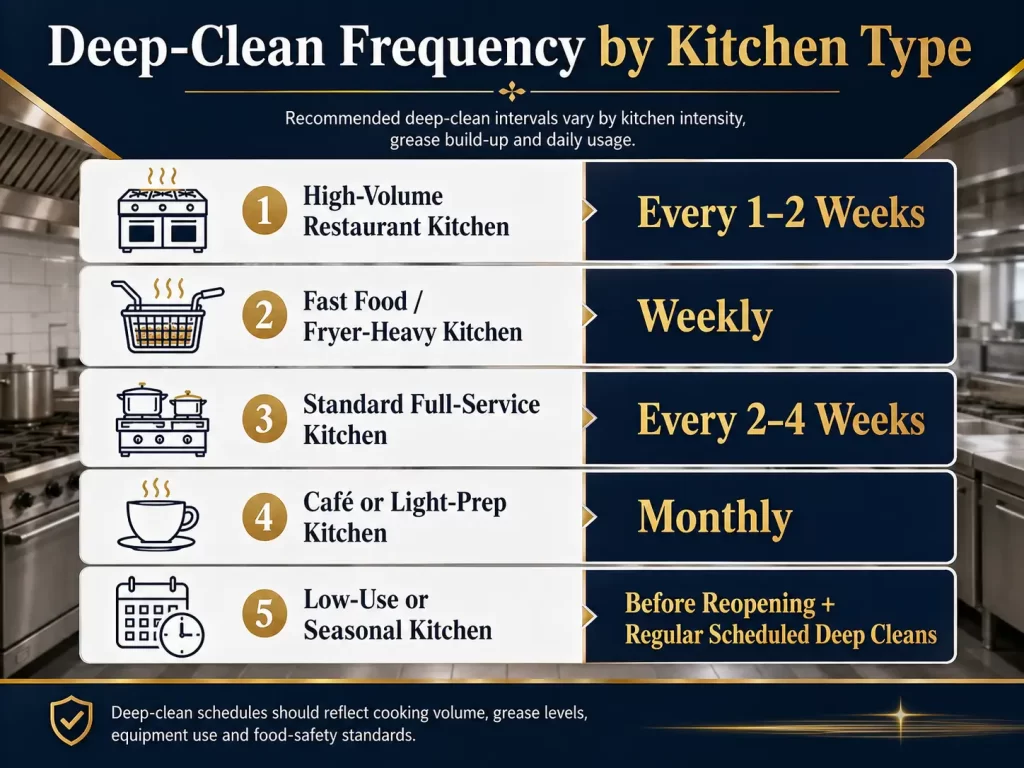
High-Volume or Grease-Heavy Kitchens
Busy restaurant kitchens that trade long hours, cook continuously, or rely heavily on frying, grilling, or other grease-heavy processes usually need a deep clean around every 3 months. This is the most common recommendation for high-pressure kitchens because grease and residue build up quickly, and routine staff cleaning alone often cannot keep up.
These kitchens often include:
- all-day service venues
- late-night restaurants
- takeaway-heavy kitchens
- sites with frequent frying or chargrilling
- kitchens with visible grease pressure around line areas and extraction-adjacent surfaces
For operators asking how often should a restaurant kitchen be deep cleaned, the best answer is to match the schedule to kitchen type rather than use one flat interval for every site.
Standard Moderate-Use Restaurant Kitchens
A standard restaurant kitchen with more balanced service hours and a solid daily cleaning routine will often work on a 6-month deep-clean cycle. This is the middle-ground schedule most often used for kitchens that are busy, but not under extreme grease or operating pressure every day.
This is often appropriate where:
- service hours are controlled
- menu type is mixed rather than heavily grease-led
- daily close-down routines are consistent
- the site is not showing obvious buildup between planned cleans
Low-Use or Seasonal Kitchens
Low-use, seasonal, or more lightly operated kitchens may sometimes work on an annual deep-clean cycle, but only where usage genuinely stays low and the kitchen does not carry the same grease or production burden as a busy restaurant. Even then, the site still needs proper routine cleaning and monitoring between deep cleans.
This is more likely to apply to:
- seasonal venues
- low-output hospitality sites
- kitchens with shorter operating windows
- kitchens with less grease-heavy food preparation
How Often Should Extraction Systems Be Cleaned?
This is where many articles get too vague.
Kitchen extraction systems often need to be treated separately from general kitchen deep cleaning. Ventilation and ductwork cleaning often works on its own 3, 6, or 12 month cycle depending on grease load and kitchen type, and TR19-related guidance is commonly used as the benchmark for this part of the cleaning schedule.
So a kitchen may be on one practical deep-clean cycle, while the extraction system follows a parallel specialist schedule.
That matters because a kitchen can appear reasonably clean at surface level while grease continues building up inside the ventilation system.
What Factors Change the Right Deep-Clean Frequency?
The right interval is not decided by one factor alone. It usually comes down to a combination of:
Service Hours
Longer hours mean more cooking, more residue, more pressure, and less recovery time between shifts.
Menu Type
Heavy frying, grilling, oil use, and high-output cooking usually increase the need for more frequent deep cleaning.
Grease Load
The faster grease builds up around equipment, splash zones, floors, and extraction-adjacent surfaces, the shorter the cleaning cycle should usually be.
Daily Cleaning Standard
A strong daily cleaning routine can support a sensible longer interval. A weak one usually shortens it.
Kitchen Layout and Access
Hard-to-reach layouts, tightly packed lines, and difficult access behind equipment can speed up hidden buildup.
Current Condition
If the kitchen already shows signs of overdue cleaning, a reactive deep clean may be needed before moving to a planned schedule.
Warning Signs Your Restaurant Kitchen Is Overdue for a Deep Clean
Even before a site reaches its planned date, there are usually clear warning signs that the kitchen is overdue.
Common signs include:
- visible grease buildup around the cookline
- sticky residue on surfaces that should clean easily
- buildup behind or under equipment
- drains or lower-level areas that no longer feel hygienic
- strong lingering smells despite routine cleaning
- visible grime around refrigeration seals, edges, or storage zones
- signs that daily cleaning is only maintaining appearances rather than controlling buildup
If those problems are already showing, the kitchen may need an immediate reset rather than waiting for the next scheduled interval.
Daily Cleaning vs Weekly Cleaning vs Periodic Deep Cleaning
These are not the same thing.
Daily Cleaning
Daily cleaning keeps the kitchen usable and hygienic between shifts. It covers routine wipe-downs, key food-contact surfaces, visible spills, bins, and standard close-down tasks.
Weekly Cleaning
Weekly cleaning often goes a little deeper into areas that do not always get full attention during daily service pressure. That may include detail cleaning around equipment, lower-use storage zones, and a more focused degreasing pass.
Periodic Deep Cleaning
Periodic deep cleaning targets the buildup that routine cleaning does not fully control. It usually includes grease-heavy areas, hidden buildup behind equipment, detailed floor-edge work, deeper sanitisation, and other high-risk kitchen zones that need more time and more intensity.
Where routine cleaning is no longer enough to control buildup, grease, and hygiene pressure, commercial deep cleaning London can support a more complete reset.
For operators asking how often should a restaurant kitchen be deep cleaned, the most practical approach is to compare the kitchen type, cooking style, and visible buildup before setting a schedule.
Recommended Restaurant Kitchen Deep-Clean Frequency by Kitchen Type
The table below shows the most practical risk-based schedule for restaurant kitchen deep cleaning, based on kitchen type, usage level, and grease load.
| Kitchen Type | Suggested Deep-Clean Frequency | Why |
|---|---|---|
| High-volume / heavy frying / extended hours | Every 3 months | Grease, residue, and hygiene pressure build up faster, especially in busy kitchens with long service hours and intensive cooking. |
| Standard moderate-use restaurant kitchens | Every 6 months | A balanced schedule often works well where daily cleaning is strong and the site is not under constant high-grease pressure. |
| Low-use or seasonal kitchens | Every 12 months | Lower-output kitchens may manage on a longer cycle, but only where use is genuinely light and standards remain controlled between cleans. |
| Extraction / ductwork systems | 3, 6 or 12 months | Ventilation systems often need a separate schedule based on grease load, kitchen type, and TR19-related guidance. |
What Managers Should Ask Before Agreeing a Cleaning Schedule
Before locking in a frequency plan, ask:
- How busy is the kitchen really?
- Is the cooking style grease-heavy?
- Is the current daily cleaning routine strong enough?
- Are hidden buildup areas already being missed?
- Does the extraction system need a separate schedule?
- Is the site on planned maintenance or reactive cleaning?
- Would quarterly cleaning prevent larger problems later?
- What would happen if the schedule slipped by several months?
These questions matter because the right schedule is not just about compliance. It is also about cost control, kitchen condition, downtime prevention, and maintaining consistent standards.
If your site needs a quote-stage scope review or a deeper operational reset, a dedicated commercial kitchen cleaning London service is usually the most relevant next step.
If you are still deciding how often should a restaurant kitchen be deep cleaned for your site, compare service intensity, cooking style, and visible buildup before agreeing the schedule.
Frequently Asked Questions
How often should a restaurant kitchen be deep cleaned?
A restaurant kitchen should usually be deep cleaned on a risk-based schedule. In practice, high-volume and grease-heavy kitchens often need deep cleaning every 3 months, standard moderate-use kitchens often work on a 6-month cycle, and lower-use or seasonal kitchens may sometimes be annual.
Is there a legal rule saying every restaurant kitchen must be deep cleaned every 6 months?
No single flat rule applies to every kitchen. Businesses need an effective cleaning schedule, and the deep-clean interval should reflect actual kitchen use, grease load, and hygiene risk.
How often should a busy restaurant kitchen be deep cleaned?
Busy, high-volume kitchens usually need more frequent deep cleaning, often around every 3 months, especially where frying, grilling, and long service hours create faster buildup.
How often should a moderate-use restaurant kitchen be deep cleaned?
A moderate-use kitchen with a good daily routine will often work on a 6-month cycle, provided the kitchen is not showing signs of overdue buildup between planned cleans.
Can a low-use kitchen be deep cleaned once a year?
Sometimes yes, but only where the kitchen is genuinely low-use or seasonal and the daily hygiene routine remains effective between deep cleans.
Is extraction cleaning on the same schedule as a kitchen deep clean?
Not always. Extraction systems often follow their own specialist 3, 6, or 12 month schedule depending on grease load and ventilation risk.
What makes a kitchen need more frequent deep cleaning?
Long service hours, high output, frying, grilling, fast grease buildup, difficult layouts, and weak daily cleaning routines all increase the need for more frequent deep cleaning.
What are the signs a kitchen is overdue for a deep clean?
Common warning signs include visible grease, sticky surfaces, buildup behind equipment, strong lingering smells, dirty floor edges, and a sense that routine cleaning is no longer properly controlling hygiene pressure.
Is daily cleaning enough on its own?
No. Daily cleaning is essential, but it usually does not replace periodic deep cleaning because it does not fully resolve hidden buildup, grease-heavy zones, or the more difficult areas of the kitchen.
What should I ask before agreeing a cleaning schedule?
Ask whether the schedule reflects your actual kitchen use, grease load, service hours, extraction burden, current condition, and whether the site needs planned maintenance or an immediate reset.
How often should a restaurant kitchen be deep cleaned before standards start to slip?
How often should a restaurant kitchen be deep cleaned in a busy trading environment depends on service hours, cooking volume, and grease load, but high-output kitchens often need a more frequent schedule than quieter sites.
How often should a restaurant kitchen be deep cleaned before standards start to slip?
If you are asking how often should a restaurant kitchen be deep cleaned where fryers and grills are used every day, the answer is usually more often because grease, residue, and hidden buildup accumulate faster in heavy-use kitchens.
How often should a restaurant kitchen be deep cleaned before standards start to slip?
Even with strong daily routines, how often should a restaurant kitchen be deep cleaned still depends on whether routine cleaning is fully controlling hidden buildup, floor-edge residue, equipment hygiene, and grease-heavy areas behind the line.
How often should a restaurant kitchen be deep cleaned before standards start to slip?
For operators wondering how often should a restaurant kitchen be deep cleaned before standards begin to slip, the best approach is to set the schedule early based on kitchen intensity rather than wait for visible grease, smells, and hygiene pressure to build up.
Final Answer
If you are asking how often should a restaurant kitchen be deep cleaned, the best answer is this: most busy kitchens should be deep cleaned on a risk-based schedule, not a generic one. In practice, that often means every 3 months for high-volume kitchens, every 6 months for moderate-use sites, and every 12 months for genuinely low-use kitchens, while extraction systems may follow their own separate schedule.
If the site also needs front-of-house or wider venue support, that usually sits under a broader restaurant cleaning London service rather than a kitchen-only schedule.
Businesses comparing kitchen-only cleaning with wider support can also review LitMex commercial cleaning services to see how kitchen, restaurant, and deep-cleaning routes fit together.
If you are still deciding how often should a restaurant kitchen be deep cleaned, the safest approach is to base the schedule on kitchen intensity rather than wait for visible hygiene problems to build up.